Table of Contents
What is Pharmaceutical Chemistry?
Pharmaceutical Chemistry is a branch of chemistry that deals with the study of organic chemistry — molecules and compounds — in combination with structural biology, chemical biology, and pharmacology for producing pharmaceutical drugs and medicines.
In simple terms, it is the complete science of drugs — covering their discovery, design, metabolism, absorption, delivery, and quality control.
Scope of Pharmaceutical Chemistry
Pharmaceutical chemistry has a wide scope across multiple fields:
- Quality Assurance & Quality Control (QA/QC) — Processes and standards that ensure the quality, safety, and efficacy of drug compounds.
- Drug Discovery — Identifying and developing new compounds that can treat diseases.
- Pharmaceutical Industry — Manufacturing, formulation, and testing of medicines.
- Teaching & Research — Pharmaceutical chemistry educators and researchers in colleges and institutions.
Sources and Types of Errors
What is an Error?
An error is defined as the deformity present in any measurement due to the addition of any internal or external factor. In pharmaceutical science, errors are induced by defective equipment, faulty methods, or human mistakes. They affect the reliability, reproducibility, accuracy, and precision of analytical results.
Types of Errors by Calculation
1. Absolute Error:
The difference between the experimentally measured mean value and the true/actual value. It may be positive or negative.
Absolute Error = Measured Mean Value − True Value
2. Relative Error:
Defined by dividing the absolute error by the true value. Expressed as a percentage (× 100) or as parts per thousand (× 1000).
Relative Error = (Measured Mean Value − True Value) ÷ True Value
Example: The actual caffeine content in tea leaves is 3.50%. An analyst measures it as 3.75%.
- Absolute Error = 3.75 − 3.50 = 0.25
- Relative Error (%) = 0.25 ÷ 3.50 × 100 = 7.14%
- Relative Error (ppt) = 0.25 ÷ 3.50 × 1000 = 71.42 ppt
Types of Errors by Nature and Source
1. Determinate (Systematic) Errors
Arise due to wrong procedures, incorrect measurements, or faulty instruments. These errors are detectable and can be eliminated by the analyst.
Sources of systematic errors:
| Source | Description |
|---|---|
| Instrumental Errors | Defective or low-quality instruments |
| Proportional Errors | Relative error remains constant regardless of sample size |
| Personal Errors | Due to carelessness, ignorance, or lack of skill (also called operative errors) |
| Chemical/Reagent Errors | Due to chemical reactivity between the chemical used and the reagent |
| Errors in Methodology | Most serious type — arises from faulty analytical methods (e.g., incomplete reactions, co-precipitation of impurities) |
2. Indeterminate (Random) Errors
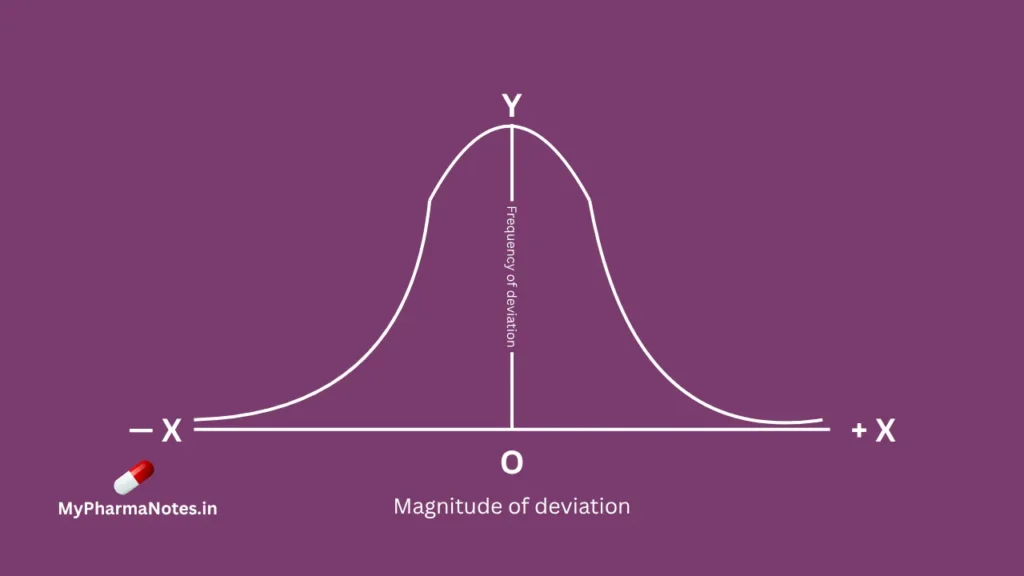
These errors have no specific known cause and cannot be eliminated — hence also called accidental errors. They follow a random distribution pattern described by the Curve of Error (normal frequency distribution curve), which shows:
- Very large errors are unlikely to occur
- Smaller errors occur with greater frequency
- Positive and negative errors occur with equal probability
How to Minimize Errors
- Calibrate all instruments and apparatus before use
- Ensure skilled and careful handling by analysts
- Choose suitable and high-quality materials
- Remove impurities and contamination from reagents
- Apply proper analytical methodology
- Conduct thorough chemical evaluation
Accuracy vs Precision
Accuracy
Accuracy is defined as how close a measured value is to the true/accepted value. It is inversely proportional to error — the lower the error, the higher the accuracy. Since no measurement is perfectly accurate, the true value is generally taken as a mean calculated from results across multiple laboratories using different techniques.
Precision
Precision is defined as the agreement among a cluster of experimental results. It represents the reproducibility of a measurement — how consistently the same result is obtained.
Important: High precision does not necessarily mean high accuracy.
Example: An analyst tests water content in milk and gets readings of 88.3, 85.4, 86.8, 88.5, and 87.9. The actual water content is 87%.
- Precision range = 85.4 to 88.5
Significant Figures
Significant figures are the number of digits necessary to express the result of a measurement consistent with the measured precision. Each digit denotes the actual quantity it specifies.
Rules for zeros:
- Zeros between non-zero digits are significant — e.g., 25.05 and 1350 each have 4 significant figures
- Zeros that only locate the decimal point are not significant — e.g., 0.0034 has only 2 significant figures
Burette example: If a burette graduated in 0.1 ml divisions is read as 7.34 ml, it contains 3 significant figures — two certain (7.3) and one uncertain (4).
Impurities in Pharmaceuticals
What are Impurities?
Impurities are defined as the presence of undesired or unexpected material in a pharmaceutical substance that may alter the final product. While absolute purity is difficult to achieve, pharmacopoeias fix acceptable limits for impurities in all official drug substances.
Sources of Impurities
Impurities may enter a drug substance at three stages:
1. During Manufacturing
| Source | Example |
|---|---|
| Raw materials | Rock salt contains calcium sulphate and magnesium chloride — traces carry into final NaCl product |
| Reagents used | Sulphuric acid used in processing often contains lead; HCl introduces chloride impurities |
| Solvents used | Toluene and n-butanol contain water as azeotrope; ethyl acetate may contain acetic acid |
| Reaction equipment | Metallic vessels corrode when contacted with certain solvents — introducing lead, antimony, bismuth |
| Intermediate products | In potassium iodide manufacture, iodate intermediate remains as an impurity |
| Manufacturing hazards | Atmospheric dust, silica, and carbon gases in industrial areas can enter the final product |
2. During Purification and Processing
- Reagents added to remove one impurity may introduce another (e.g., BaCl₂ added to remove sulphates from AlCl₃ may leave barium as a new impurity)
- Solvents used for purification — organic solvents, acids, and water — can carry their own impurities
- Unclean or defective purification vessels (filters, centrifuges, dryers) may add metallic ions, rust, or moisture
3. During Storage and Packaging
- Substandard packaging materials (e.g., low-quality aluminium foil for tablet strips) allow entry of atmospheric moisture or contaminants
- Faulty automated packaging processes (improper heat sealing) may cause contamination
- Microbial contamination — fungal and bacterial growth due to improper storage; especially critical for parenteral and ophthalmic preparations which require sterility testing
Effects of Impurities
- Lower the active strength of the drug substance when present above acceptable limits
- Cause incompatibility and deterioration of the original substance
- Alter chemical behaviour and reactivity of the drug
- May produce cumulative toxic effects even when present in traces
- Promote microbial growth, leading to further deterioration
- Catalyze degradation and shorten the shelf life of the drug
- Change physical properties such as appearance, taste, odour, and stability
- Create technical difficulties in formulation
Limit Tests
What is a Limit Test?
A limit test is defined as a quantitative or semi-quantitative test performed to identify and control small amounts of impurities likely to be present in a substance. Limit tests are not based on numerical values — they involve a visual comparison of turbidity, opalescence, or colour intensity between the test sample and a standard solution.
Importance of Limit Tests
- Identify the presence and amount of inorganic impurities in a substance
- Detect incompatibilities between dissolved substances
- Distinguish between avoidable and non-avoidable impurities
- Help ensure the purity and clarity of pharmaceutical substances
Pharmacopoeia Standard for Test Solution Preparation
| Substance Type | Preparation Method |
|---|---|
| General substances | Dissolve in distilled water; make up to 50 ml in Nessler’s cylinder |
| Alkaline substances (hydroxides, carbonates) | Dissolve in sufficient acid until effervescence ceases |
| Insoluble substances (kaolin) | Prepare water extract, filter, and use filtrate |
| Salts of organic acids (sodium benzoate) | Acidify to liberate the free acid, filter off, use filtrate |
| Coloured substances (crystal violet, malachite green) | Carbonize, extract ash in water |
| Reducing substances (nitrites, hypophosphates) | Oxidize with oxidizing agents before use |
| Potassium permanganate | Reduce by boiling with alcohol, use filtrate |
Limit Test for Chlorides
Apparatus: Nessler’s cylinder, pipette, stirring rod, beaker, stand Chemicals: Dilute nitric acid (10%), silver nitrate (5%), test sample, standard sample (sodium chloride)
Chemical Reaction:
Cl⁻ + AgNO₃ → AgCl↓ + NO₃⁻ (in dilute HNO₃)
Principle: Chloride ions react with silver nitrate in a nitric acid medium to form insoluble silver chloride, which renders the solution turbid. The turbidity of the test solution is compared with a standard. If the test solution shows less turbidity than the standard, the sample passes.
Procedure:
| Test | Standard |
|---|---|
| Dissolve test sample in water; transfer to Nessler cylinder | Take 1 ml of standard NaCl solution (0.05845% w/v) |
| Add 1 ml dilute nitric acid; make up to 50 ml with water | Add 10 ml nitric acid; make up to 50 ml with water |
| Add 1 ml silver nitrate; stir immediately; set aside 5 minutes | Add 1 ml silver nitrate; stir immediately; set aside 5 minutes |
| Compare opalescence with standard | Compare opalescence with test |
Limit Test for Sulphates
Apparatus: Nessler’s cylinder, pipette, stirring rod, beaker, stand Chemicals: Dilute hydrochloric acid, barium chloride, test sample, standard sample (potassium sulphate)
Chemical Reaction:
SO₄²⁻ + BaCl₂ → BaSO₄↓ + 2Cl⁻ (in dilute H₂SO₄)
Principle: The test solution is mixed with barium chloride in the presence of dilute hydrochloric acid to produce turbidity. The turbidity is compared with a standard sulphate solution. The substance passes if its turbidity is less than the standard.
Limit Test for Iron
Apparatus: Nessler’s cylinder, pipette, stirring rod, beaker, stand Chemicals: Test sample, standard iron solution (ferric ammonium sulphate), iron-free citric acid, iron-free ammonia solution, thioglycollic acid.
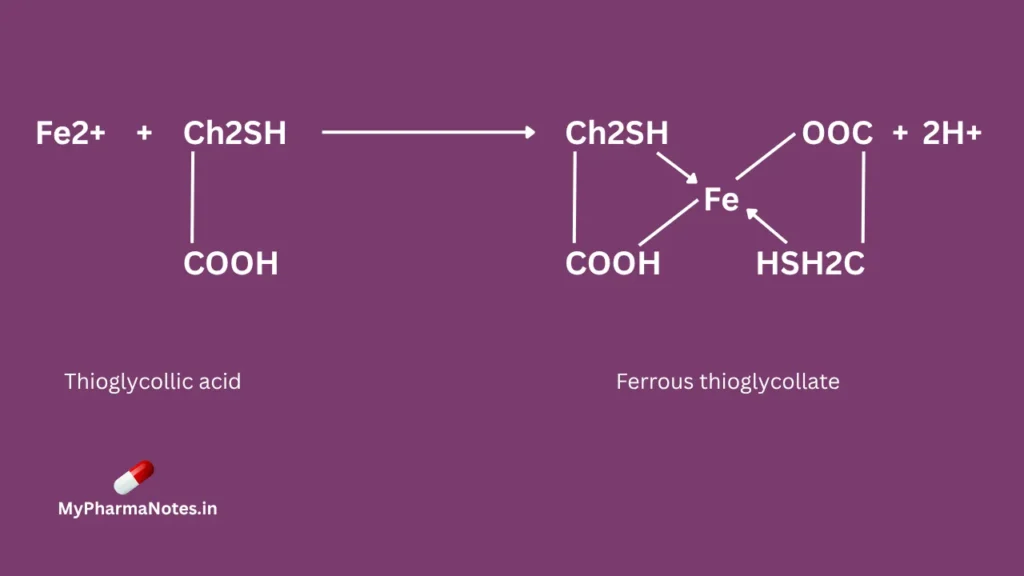
Chemical Reaction:
Fe²⁺ + Thioglycollic acid → Iron-thioglycollate complex (pink to reddish-purple)
Principle: Iron in an ammoniacal solution reacts with thioglycollic acid to form a pink to deep reddish-purple coloured complex. Thioglycollic acid also reduces Fe³⁺ to Fe²⁺, so the original state of iron is unimportant. Citric acid (20%) is used to form complexes with interfering metal ions. If the colour of the test solution is less dark than the standard, the sample passes.
Procedure:
| Test | Standard |
|---|---|
| Dissolve test sample in water in Nessler cylinder; make to 40 ml | Take 2 ml of standard iron solution; make to 40 ml |
| Add 2 ml of 20% w/v iron-free citric acid + 0.1 ml thioglycollic acid | Add 2 ml of 20% w/v iron-free citric acid + 0.1 ml thioglycollic acid |
| Make alkaline with iron-free ammonia solution; make to 50 ml | Make alkaline with iron-free ammonia solution; make to 50 ml |
| Compare purple colour intensity by viewing vertically | Compare with test solution |
Limit Test for Heavy Metals
Apparatus: Nessler’s cylinder, pipette, stirring rod, beaker, stand Chemicals: Test sample, standard lead solution, dilute acetic acid, dilute ammonia, dilute sodium hydroxide, hydrogen sulphide solution
Chemical Reactions:
Pb(NO₃)₂(Pb+) + H₂S → PbS↓ + 2HNO₃
PbCl₂ + Na₂S → PbS↓ + 2NaCl
Principle: Heavy metal ions react with hydrogen sulphide under acidic conditions to form metal sulphides, which remain in a colloidal state and produce a brownish coloration. The quantity of metallic impurities is expressed as parts of lead (Pb) per million (ppm). The standard limit as per Indian Pharmacopoeia is 20 ppm.
Method 1 (Hydrogen Sulphide Method):
| Test | Standard |
|---|---|
| Take solution in Nessler cylinder; make to 25 ml | Take 2 ml of standard lead solution; make to 25 ml |
| Adjust pH to 3–4 with dilute acetic acid or ammonia | Adjust pH to 3–4 with dilute acetic acid or ammonia |
| Add water to 35 ml; then add 10 ml freshly prepared H₂S solution; make to 50 ml | Same procedure |
| Allow to stand 5 minutes; observe black ppt of lead sulphide | Compare with test |
Method 2 (Sodium Sulphide Method):
| Test | Standard |
|---|---|
| Test sample + 20 ml water in Nessler cylinder | 2 ml standard solution + 20 ml water |
| Add 5 ml dilute NaOH; make to 50 ml | Add 5 ml dilute NaOH; make to 50 ml |
| Add 5 drops sodium sulphide solution; stir; set aside 5 minutes | Same procedure |
| Observe colour darkness; compare with standard | Compare with test |
Limit Test for Arsenic
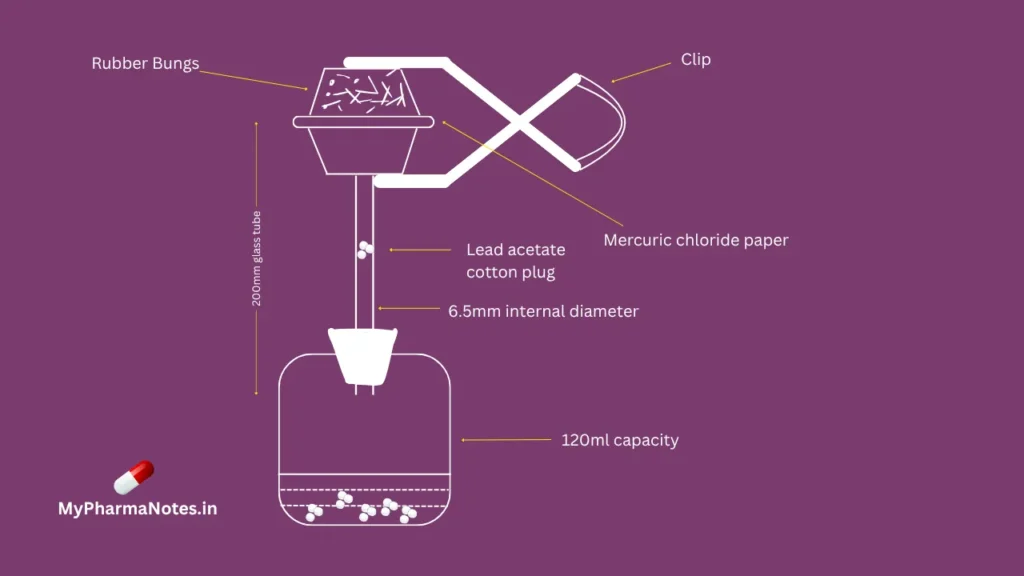
Apparatus: Arsenic limit test apparatus (Gutzeit apparatus), white filter paper, pipette, stirring rod, beaker, stand Chemicals: Test sample, standard arsenic solution, lead acetate solution, potassium iodide, zinc, mercuric chloride paper.
Chemical Reactions:
Zn + 2HCl → ZnCl₂ + 2H
2As + 6H → 2AsH₃↑
HgCl₂ + AsH₃ → HgCl₂·AsH₃ (Yellow complex)
Principle: Based on the Gutzeit test. Arsenic acid is reduced to arsenous acid, which is further reduced to arsine gas (AsH₃). This gas reacts with mercuric chloride paper to produce a yellow stain. The intensity of the stain is proportional to the amount of arsenic present.
A lead acetate-soaked cotton plug in the apparatus traps hydrogen sulphide gas (which would also react with the paper), ensuring only arsenic-related staining occurs.
Apparatus Details:
- 120 ml wide-mouth bottle fitted with rubber bung
- 200 mm long glass tube (6.5 mm internal diameter) with a 2 mm hole at one end
- Mercuric chloride paper sandwiched between rubber bungs (25 × 25 mm) held by a clip
Procedure:
| Test | Standard |
|---|---|
| Dissolve test sample in water + stannous hydrochloric acid; place in apparatus bottle | Dilute standard arsenic solution in apparatus bottle |
| Add 1 g potassium iodide + 5 ml stannous chloride + 10 g zinc (all arsenic-free) | Same reagents added |
| Set aside for 40 minutes | Set aside for 40 minutes |
| Compare yellow stain on mercuric chloride paper with standard | Compare with test stain |
D.Pharma 1st Year — All Subjects Notes
D.Pharma 2nd Year — All Subjects Notes
