Table of Contents
What is Nomenclature?
Nomenclature is the systematic method of naming organic chemical compounds. Two major naming systems are used in organic chemistry — the Common Naming System and the IUPAC Naming System.
Classification of Organic Compounds Based on Carbon Chain
Organic compounds are first classified based on the structure of their carbon chain:
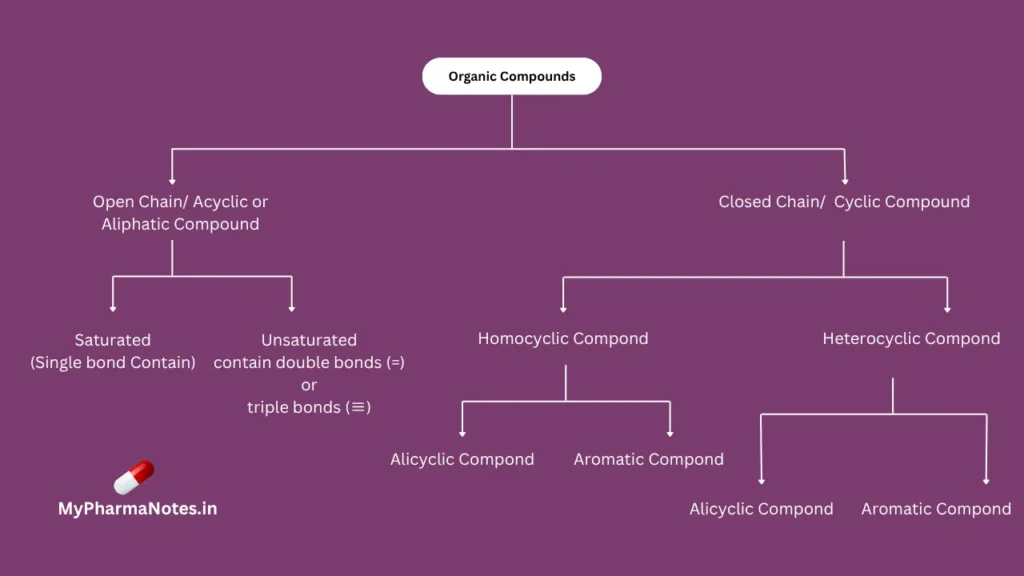
1. Open Chain / Acyclic / Aliphatic Compounds
- Saturated — contain only single bonds
- Unsaturated — contain double bonds (=) or triple bonds (≡)
2. Closed Chain / Cyclic Compounds
- Homocyclic compounds — ring contains only carbon atoms
- Alicyclic compounds
- Aromatic compounds
- Heterocyclic compounds — ring contains carbon plus other atoms (N, O, S)
- Alicyclic compounds
- Aromatic compounds
1. Common Naming System
A. Naming Based on Source
| Chemical | Common Name | Source |
|---|---|---|
| CH₄ | Marsh gas | Marshy places |
| CH₃COOH | Acetic acid | Vinegar |
| HCOOH | Formic acid | Red ant |
| CH₃OH | Methyl alcohol / Wood spirit | Wood destructive distillation |
B. Naming Based on Hydrocarbons (Radical Independent)
Carbon chain prefix names:
| Number of Carbons | Prefix |
|---|---|
| 1C | Form- |
| 2C | Acet- |
| 3C | Propion- |
| 4C | Butyr- |
| 5C | Valer- |
Special unsaturated chain names:
- 3 carbons with one double bond → Acryl-
- 4 carbons with one double bond → Croton-
Functional group suffixes:
| Functional Group | Suffix |
|---|---|
| -CHO | Aldehyde |
| -COOH | -ic acid |
| -COOR | Alkyl-ate |
| -COX | Alkyl halide |
| -CONH₂ | Amide |
| -CN | -onitrile |
Bond type suffixes (radical dependent):
| Bond Type | Suffix |
|---|---|
| Single bond (–) | -ane |
| Double bond (=) | -ene |
| Triple bond (≡) | -yne |
Saturated Hydrocarbons (Alkanes) — CₙH₂ₙ₊₂
Suffix used: -ane
- Unbranched hydrocarbon → use prefix n- (normal)
- One methyl group on 2nd carbon → use prefix iso-
- Two methyl groups on 2nd carbon → use prefix neo-
Note: When one hydrogen is removed from an alkane, a monovalent radical (alkyl) is formed.
Example: -CH₃ = methyl | -C₂H₅ = ethyl
Unsaturated Hydrocarbons
- Double bond (CₙH₂ₙ) → suffix -ene
- Triple bond (CₙH₂ₙ₋₂) → suffix -yne
Unsaturated radicals:
- -CH₂=CH– → Vinyl
- -CH₂-CH=CH₂ → Allyl
Functional group suffixes (for radicals):
| Functional Group | Suffix |
|---|---|
| -OH | Alcohol |
| -NH₂ | Amine |
| -O- | Ether |
| -S- | Thioether |
| -X | Halide |
| -CN | Cyanide |
| -CO- | Ketone |
2. IUPAC Naming System
The IUPAC (International Union of Pure and Applied Chemistry) system is the most standardised and universally accepted naming system for organic compounds.
Rules for IUPAC Naming
A. Selection of the longest continuous parent carbon chain
Priority order for selecting the parent chain:
Functional group > Multiple bond > Number of carbon atoms > Substituents
B. Numbering the selected parent carbon chain
Priority order for numbering:
Functional group > Multiple bond > Substituents
IUPAC Functional Group Prefixes and Suffixes
| S.No. | Functional Group | Prefix | Suffix |
|---|---|---|---|
| 1 | -(C)OOH (carboxylic acid) / -COOH | carboxy | -oic acid / carboxylic acid |
| 2 | -SO₃H (sulphonic acid) | sulpho | -sulphonic acid |
| 3 | -(C)OOR (ester) / -COOR | alkoxycarbonyl / carbalkoxy | alkyl-oate / alkyl-carboxylate |
| 4 | -(C)OX (acid halide) / -COX | haloformyl | -oyl halide / carbonyl halide |
| 5 | -(C)ONH₂ (amide) / -CONH₂ | carbamoyl | -amide / carbonitrile |
| 6 | -(C)N (cyanide) / -CN | cyano | -nitrile / carboxamide |
| 7 | -(C)HO (aldehyde) / -CHO | oxo / formyl | -al / carbaldehyde |
| 8 | -OH (alcohol) | hydroxy | -ol |
| 9 | -SH (thioalcohol) | mercapto | -thiol |
| 10 | -NH₂ (amine) | amino | -amine |
Bond Type Suffixes
| Bond Type | Suffix |
|---|---|
| Single bond (–) | -ane |
| Double bond (=) | -ene |
| Triple bond (≡) | -yne |
Carbon Chain Root Words
| Number of Carbons | Root Word |
|---|---|
| 1C | Meth- |
| 2C | Eth- |
| 3C | Prop- |
| 4C | But- |
| 5C | Pent- |
| 6C | Hex- |
| 7C | Hept- |
| 8C | Oct- |
Substituent Prefixes
| Substituent | Prefix |
|---|---|
| -R (alkyl group) | Alkyl- |
| -NH₂ | Amino |
| -O-N=O | Nitrite |
| -OCH₂CH₃ | Ethoxy |
| -CH₂-Cl | Chloromethyl |
| -S- | Thio |
| -X (halogen) | Halo |
Procedure for Writing IUPAC Names
The complete IUPAC name is built in this order:
(Secondary prefix) + (Primary prefix) + (Word root) + (Primary suffix) + (Secondary suffix)
| Part | Meaning |
|---|---|
| Secondary prefix | Substituents with locants (position numbers) |
| Primary prefix | Cyclic group indicator (cyclo-) |
| Word root | Number of carbons in the parent chain |
| Primary suffix | Bond type — -ane, -ene, -yne |
| Secondary suffix | Principal functional group |
Important rules:
- Numbers and alphabets are separated by a hyphen (-)
- Di-, tri-, iso-, neo-, and cyclo- are neither separated by comma nor hyphen
- The first letter of the name is always a capital letter
- A space is required between parts of the name
- When more than one substituent is present, list them in alphabetical order
Heterocyclic Ring Systems in Pharmaceutical Chemistry
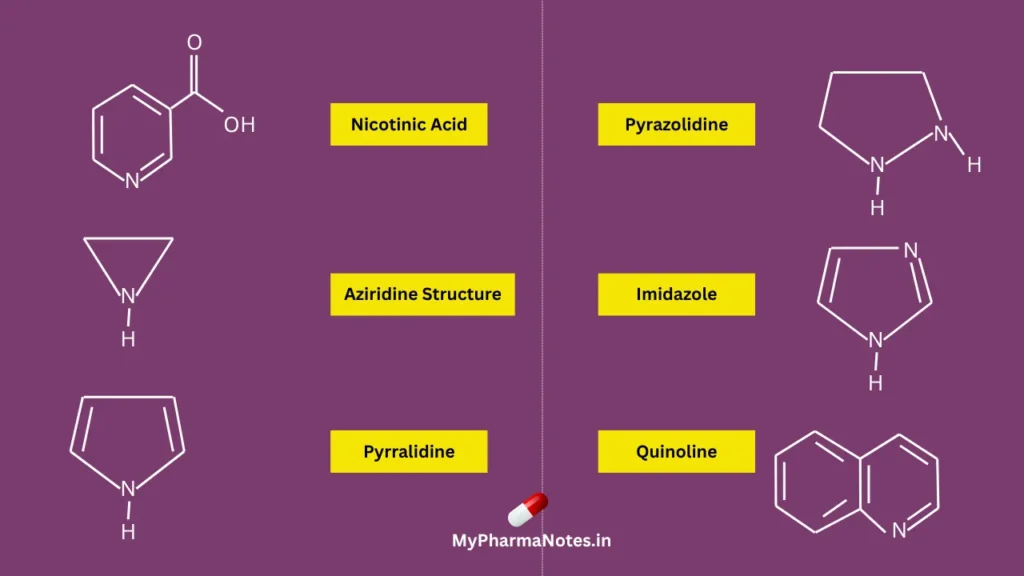
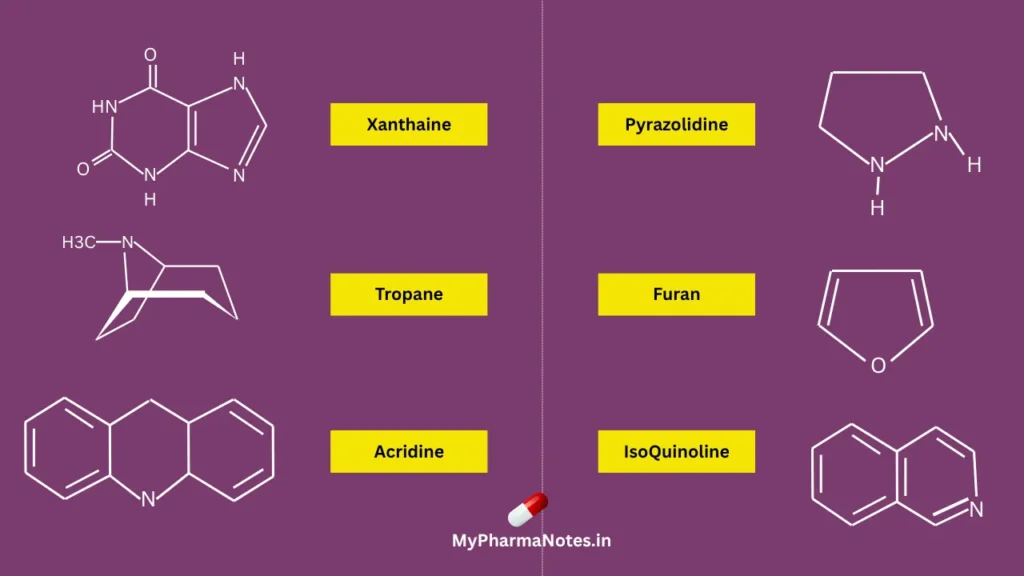
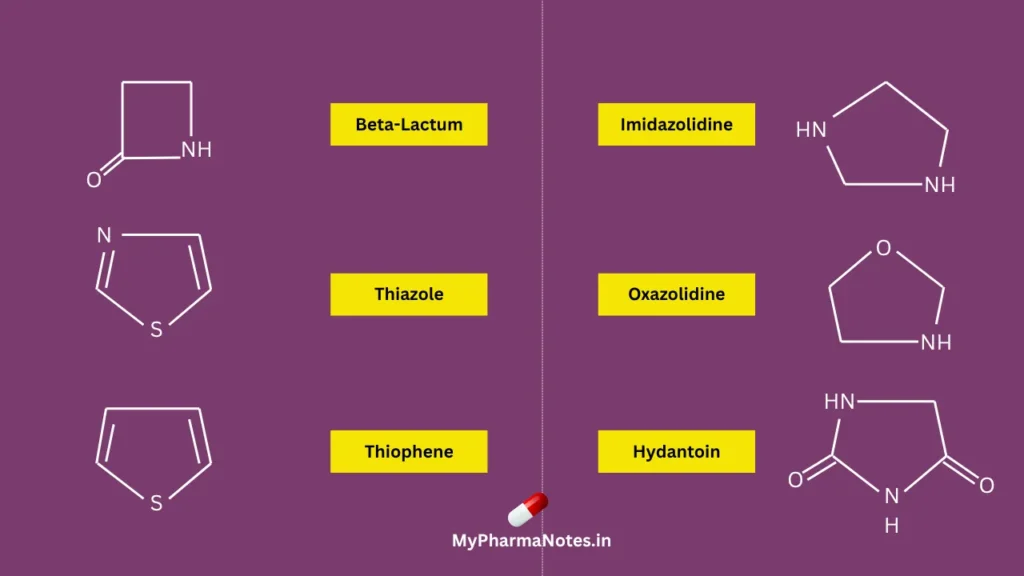
Heterocyclic rings are cyclic compounds containing atoms other than carbon in the ring — most commonly nitrogen (N), oxygen (O), or sulphur (S). They are extremely important in pharmaceutical chemistry as they form the core structural framework of most drugs.
Common Heterocyclic Ring Structures
Nitrogen-containing rings:
| Ring Name | Key Feature |
|---|---|
| Aziridine | 3-membered ring with one N |
| Pyrrolidine | 5-membered ring with one N |
| Pyrazolidine | 5-membered ring with two adjacent N |
| Imidazole | 5-membered aromatic ring with two N |
| Imidazolidine | Saturated imidazole ring |
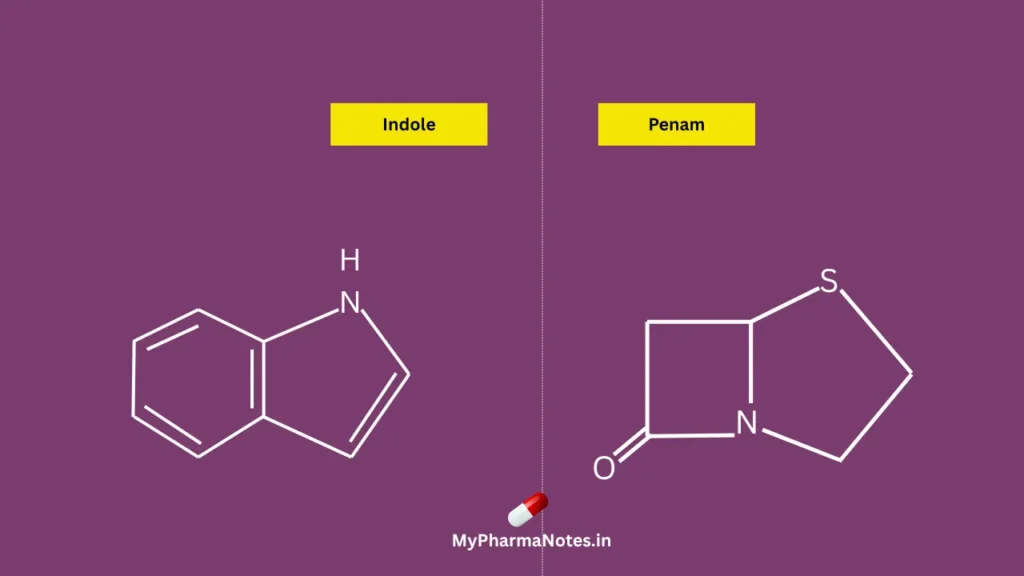
| Indole | Bicyclic — benzene fused with pyrrole |
| Quinoline | Bicyclic — benzene fused with pyridine |
| Isoquinoline | Isomer of quinoline |
| Acridine | Tricyclic nitrogen-containing ring |
| Tropane | Bicyclic ring — found in atropine, cocaine |
| Xanthine | Bicyclic — found in caffeine, theobromine |
| Hydantoin | 5-membered ring — found in phenytoin (anticonvulsant) |
Sulphur-containing rings:
| Ring Name | Key Feature |
|---|---|
| Thiazole | 5-membered ring with N and S |
| Isothiazole | Isomer of thiazole |
| Thiophene | 5-membered aromatic ring with S |
Oxygen-containing rings:
| Ring Name | Key Feature |
|---|---|
| Furan | 5-membered aromatic ring with O |
| Oxazolidine | 5-membered ring with N and O |
Pharmaceutical importance — antibiotic ring systems:
| Ring Name | Key Feature |
|---|---|
| β-Lactam | 4-membered ring with N and C=O — found in penicillin, cephalosporins |
| Penam | Bicyclic system — core of penicillin antibiotics |
Quick Summary Table — IUPAC Naming Steps
| Step | Action |
|---|---|
| 1 | Identify the principal functional group |
| 2 | Select the longest carbon chain containing the principal functional group |
| 3 | Number the chain — give lowest locant to the principal functional group |
| 4 | Identify all substituents and their positions |
| 5 | Identify bond types (single/double/triple) and their positions |
| 6 | Assemble the name: secondary prefix + primary prefix + root + primary suffix + secondary suffix |
D.Pharma 1st Year — All Subjects Notes
D.Pharma 2nd Year — All Subjects Notes
