Table of Contents
What is Pharmaceutical Analysis?
Pharmaceutical Analysis is a branch of medicinal chemistry that includes a series of experiments and procedures for the purification, identification, determination, quantitation, and characterisation of any chemical compound or component.
In simple terms, it is the science of testing drugs — confirming their identity, measuring their concentration, and ensuring they meet the required standards of purity, quality, and safety.
Pharmaceutical analysis and quality control together play a vital role in ensuring drug stability, compatibility, potency, efficacy, and safety in pharmaceutical manufacturing.
Methods of Pharmaceutical Analysis
- Chemical / Titrimetric methods
- Biological methods
- Physical and physicochemical methods
- Pharmaceutical methods
Common Apparatus Used
Nessler Cylinders, Gas Detector Tubes, Sieves, Thermometers, Ultraviolet Ray Lamps, Volumetric Glassware, Weights and Balances.
Key Terms and Formulas
| Term | Formula |
|---|---|
| Concentration | Moles of solute ÷ Volume in litres |
| Mass % (w/w) | (Mass of component ÷ Total mass of solution) × 100 |
| Volume % (v/v) | (Volume of component ÷ Total volume of solution) × 100 |
| Mass by Volume % (m/v) | (Mass of solute ÷ Volume of solution) × 100 |
| Molarity | Moles of solute ÷ Volume of solution in litres |
| Molality | Moles of solute ÷ Mass of solvent in kg |
| Normality | Gram equivalents of solute ÷ Litres of solution |
| PPM | (Parts of component ÷ Total parts of all components) × 10⁶ |
| Mole Fraction | Moles of component ÷ Total moles of all components |
Chemical / Titrimetric Methods
Volumetric Analysis
Volumetric analysis is a method of quantitative chemical analysis in which the amount of a substance is determined by measuring the volume it occupies in chemical reactions. It is widely used in pharmaceutical analysis because of its robustness, low cost, and high precision.
Types of volumetric methods:
- Neutralisation Titration
- Non-aqueous Titration
- Redox Titration
- Complexometric Titration
- Precipitation Titration
1. Neutralisation Titration (Acid-Base Titration)
What is Titration?
Titration is the process of determining the unknown concentration of a solution (analyte) by reacting it with a standard solution of known concentration (titrant) until the reaction is complete.
Acid-Base Theories
Acids:
| Concept | Definition | Examples |
|---|---|---|
| Arrhenius | Produces free H⁺ ions in aqueous solution | HCl, HNO₃, H₂SO₄, CH₃COOH |
| Bronsted-Lowry | Donates a proton (H⁺) in any solvent | Same as above |
| Lewis | Accepts a lone pair/electron pair | AlCl₃, SF₆, SO₃ |
Bases:
| Concept | Definition | Examples |
|---|---|---|
| Arrhenius | Produces free OH⁻ ions in aqueous solution | NaOH, KOH, Ca(OH)₂ |
| Bronsted-Lowry | Accepts a proton (H⁺) in any solvent | SO₄²⁻, Cl⁻, O²⁻ |
| Lewis | Donates a lone pair/electron pair | NH₃, amines |
Types of Neutralisation Titration
A. Strong Acid / Strong Base Titration
Strong acid and strong base react rapidly, breaking into ions and forming salt and water. The neutralisation point occurs at pH 7.
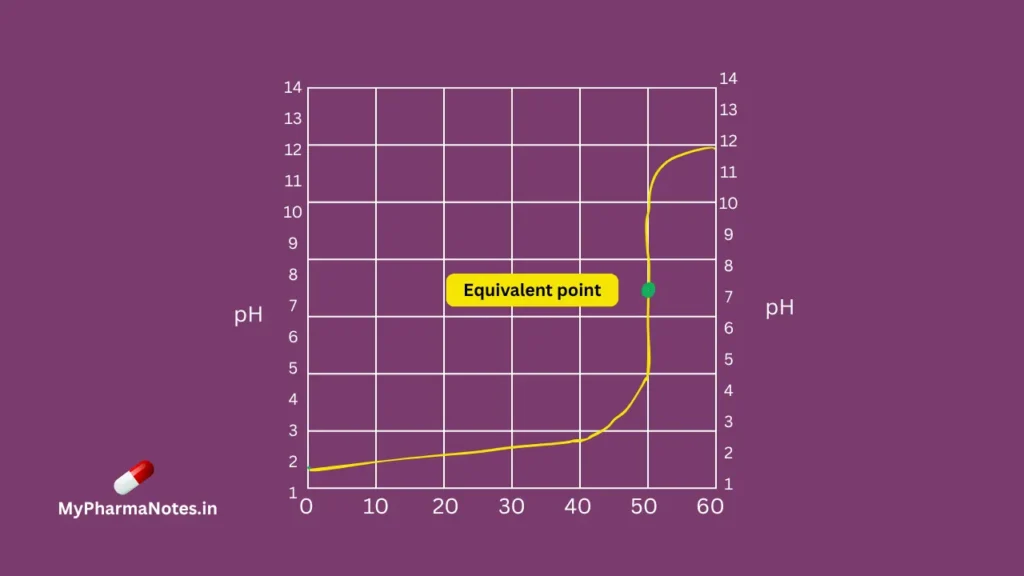
Titration curve characteristics (HCl vs NaOH):
- Initially low pH due to excess acid
- pH rises slowly as base is added
- Sharp rise occurs near the equivalence point
- pH above 7 after equivalence point due to excess alkali
- All strong acid/strong base curves have the same shape
B. Weak Acid / Strong Base and Weak Base / Strong Acid Titration
The weak component dissociates slowly while the strong component dissociates rapidly — making this titration different from A above.
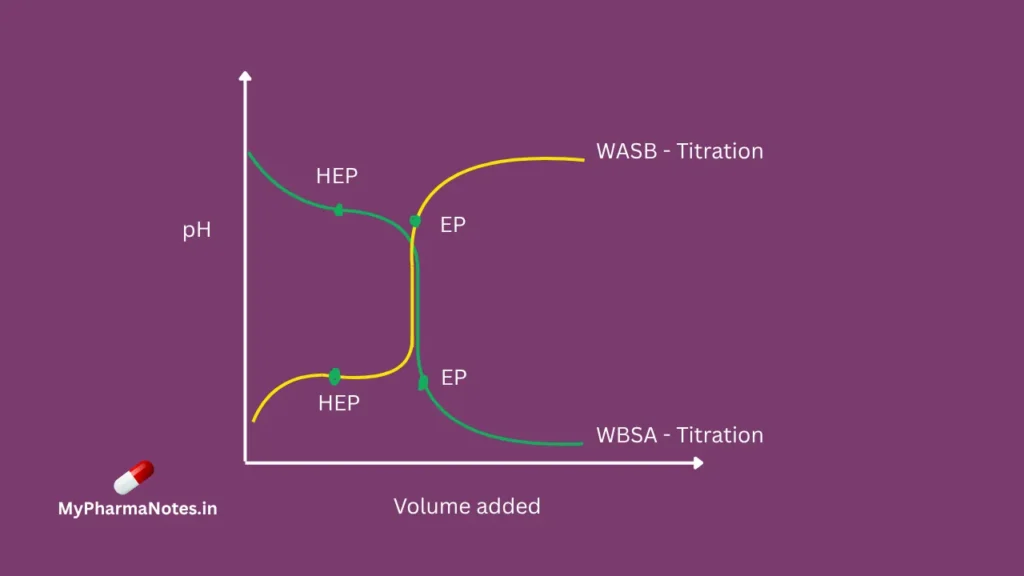
Titration curve characteristics:
- pH rises gradually at first
- A flat zone (half neutralisation point) is observed where pH = pKa of the weak acid
- At this point a buffer solution is formed (mix of weak acid and its conjugate base)
- After the buffer zone, a sharp pH rise occurs above pH 7 at the equivalence point
C. Weak Acid / Weak Base Titration
The change in pH near the equivalence point is very gradual throughout the entire neutralisation. Ordinary indicators cannot detect the endpoint — mixed indicators must be used.
Back Titration
Used when direct titration is not possible — for insoluble substances, volatile substances, or reactions requiring excess reagent. A known excess of standard solution is added to the analyte, and after the reaction is complete, the excess is back-titrated with another standard solution.
Important Neutralisation Titrations — Summary Table
| Drug / Chemical | Titration Type | Titrant |
|---|---|---|
| Aspirin | Back | H₂SO₄ |
| Ammonium chloride | Back | NaOH |
| Methyl salicylate | Back | HCl |
| Ephedrine | Back | NaOH |
| Furosemide | Back | NaOH |
| Pyrazinamide | Back | NaOH |
| Sodium hydroxide | Direct | H₂SO₄ |
| Thiopentone sodium | Direct | H₂SO₄ |
| Calamine | Direct | NaOH |
| Oxyphenbutazone | Direct | NaOH |
| Salicylic acid | Direct | NaOH |
| Boric acid | Direct | NaOH |
| Hydrochloric acid | Direct | NaOH |
| Nicotinic acid | Direct | NaOH |
| Saccharin | Direct | NaOH |
Neutralisation Indicators
Indicators are substances that give a visible sign — usually a colour change — indicating the presence or absence of a threshold concentration of acid or alkali in a solution.
| Indicator | pH Range | Acid Colour | Base Colour |
|---|---|---|---|
| Thymol blue | 1.2 – 2.8 | Red | Yellow |
| Methyl red | 4.2 – 6.3 | Red | Yellow |
| Methyl orange | 3.1 – 4.4 | Red | Orange |
| Bromocresol green | 3.8 – 5.4 | Yellow | Blue |
| Bromocresol blue | 3.0 – 4.6 | Yellow | Blue |
| Phenol red | 6.8 – 8.4 | Yellow | Red |
| Phenolphthalein | 8.3 – 11.0 | Colourless | Red |
2. Non-Aqueous Titration
Non-aqueous titration is the most common titration used in pharmacopoeial assays. It is suitable for weak acids and weak bases that are poorly soluble in water and have low reactivity in aqueous conditions.
Why not use water? Water is amphoteric — it competes with weak acids and weak bases for protons. If the acid or base is relatively weak, it cannot compete effectively with water, and titration becomes unreliable.
Types of Non-Aqueous Solvents
| Solvent Type | Properties | Examples |
|---|---|---|
| Protogenic | Strong acidic character; high dielectric constant; levelling effect on bases | Formic acid, acetic acid, sulphuric acid |
| Protophilic | Basic nature; accepts protons; high dielectric constant | Dimethyl formamide, pyridine, ammonia |
| Aprotic | Chemically neutral; no O-H or N-H bonds; low dielectric constant; not ionised | Benzene, acetone, chloroform |
| Amphiprotic | Both acidic and basic properties; high dielectric constant; partially ionised | Water, ethanol, isopropyl alcohol |
Types of Non-Aqueous Titration
A. Titration of Weak Bases Acetic acid is used as solvent. Acetous perchloric acid is the titrant. Weak bases compete effectively with acetic acid for protons.
Pharmacopoeial drugs titrated by this method: Adrenaline, Metronidazole, Codeine, Amitriptyline HCl, Lignocaine HCl, Neostigmine bromide, Pancuronium bromide.
Indicators used: Oracet blue, Quinolidine red, Crystal violet.
B. Titration of Weak Acids Alcohol or aprotic solvent is used. Titrants used are lithium methoxide in methanol or tetrabutyl ammonium hydroxide in dimethyl formamide.
Pharmacopoeial drugs titrated by this method: Barbiturates, Uracils, Sulphonamides.
Indicator used: Thymol blue.
3. Redox Titration
Redox titration involves both oxidation and reduction reactions.
Oxidation = addition of oxygen / loss of electron / removal of hydrogen Reduction = removal of oxygen / gain of electron / addition of hydrogen
Example redox reaction: MnO₄⁻ + I⁻ → Mn²⁺ + I₂
Oxidising agent — accepts electrons; decreases in positive valency or increases in negative valency.
Reduction potential (E⁰) — measures how readily a compound gains electrons. A higher positive value = stronger oxidising agent.
Standard Reduction Potentials Table
| Reaction | E⁰ Value |
|---|---|
| Ce⁴⁺ + e⁻ → Ce³⁺ | +1.61 V |
| Mn⁷⁺ → Mn²⁺ | +1.51 V |
| Cl₂ + 2e⁻ → 2Cl⁻ | +1.36 V |
| Br₂ + 2e⁻ → 2Br⁻ | +1.065 V |
| Fe³⁺ + e⁻ → Fe²⁺ | +0.771 V |
| I₂ + 2e⁻ → 2I⁻ | +0.536 V |
| AgCl + e⁻ → Ag + Cl⁻ | +0.223 V |
| 2H⁺ + 2e⁻ → H₂ | 0 V |
| Fe²⁺ + 2e⁻ → Fe | −0.440 V |
| Ca²⁺ + 2e⁻ → Ca | −2.888 V |
A substance with a higher reduction potential will oxidise one with a lower reduction potential. Example: Cl₂ + 2Br⁻ → 2Cl⁻ + Br₂
Direct Redox Titration — Iodine (moderately strong oxidising agent) oxidises substances with lower reduction potential. End point detected using starch indicator (blue colour with excess iodine). Pharmacopoeial assays: Ascorbic acid, Sodium stibogluconate, Dimercaprol injection, Acetarsal.
Displacement Redox Titration — Used in assays of Liquefied phenol, Methyl hydroxybenzoate, Propyl hydroxybenzoate, Phenidione.
4. Complexometric Titration
This titration involves the formation of a complex between the titrant and the analyte. It is used to estimate metals and their salts. The titrant is called a ligand.
EDTA (Ethylenediamine Tetraacetic Acid / Sodium Edetate) — the most widely used titrant. Forms stable 1:1 complexes with all metals except alkali metals (Na, K). The general reaction:
Mⁿ⁺ + Na₂EDTA → (MEDTA)ⁿ⁻⁴ + 2H⁺
Alkaline earth metals (Ca, Mg) form complexes unstable at low pH — titrated in ammonium chloride buffer at pH 10.
Indicators used: Calcein, Eriochrome Black T, Curcumin, Calcon, Murexide (ammonium purpurate), Hematoxylin, Fast Sulphon Black.
Pharmacopoeial drugs titrated: Calcium acetate, Calcium chloride, Calcium gluconate, Magnesium carbonate, Magnesium hydroxide, Magnesium trisilicate, Bismuth subcarbonate, Bacitracin zinc, Zinc chloride, Zinc undecanoate.
Types of Complexometric Titration
- Direct complexometric titration
- Back complexometric titration
- Replacement complexometric titration
- Indirect complexometric titration
Back titration with EDTA is used for insoluble metal salts: Aluminium glycinate, Aluminium hydroxide, Aluminium sulphate, Calcium hydrogen phosphate.
5. Precipitation Titration
In precipitation titration, the titrant reacts with the analyte to form an insoluble precipitate. The end point is reached when no more precipitate forms.
Methods of Precipitation Titration
A. Mohr’s Method
Determines chloride ion concentration. Silver nitrate is slowly added to the chloride solution.
Ag⁺(aq) + Cl⁻(aq) → AgCl(s)
When all chloride is precipitated, excess silver ions react with potassium chromate indicator to form a red-brown precipitate of silver chromate — this is the end point.
2Ag⁺(aq) + CrO₄²⁻(aq) → Ag₂CrO₄(s)
Must be carried out at pH 6.5–9.0. Used for chloride determination in river water, sea water, and stream water.
B. Volhard’s Method
Used for chloride determination by back titration with potassium thiocyanate. Excess silver nitrate is first added; then Fe³⁺ is added as indicator and the solution is titrated with potassium thiocyanate.
Ag⁺(aq) + Cl⁻(aq) → AgCl(s) — first precipitation Ag⁺(aq) + SCN⁻(aq) → AgSCN(s) — pale yellow precipitate Fe³⁺(aq) + SCN⁻(aq) → [FeSCN]²⁺(aq) — dark red end point
Used under acidic pH conditions. Modified Volhard’s method is used specifically for NaCl and KCl determination.
C. Fajan’s Method
Uses adsorption indicators — dyes that adsorb or desorb on the precipitate surface at the equivalence point, producing a colour change. Indicators used: Fluorescein, Eosin (acid dyes); Rhodamine series (basic dyes).
Fluorescein forms a yellow-green colour in solution and is the most commonly used indicator for titrating chloride ions with silver.
Note: Sodium chloride can be estimated by Volhard’s method, Mohr’s method, or Fajan’s method.
Gravimetric Analysis
Principle: Gravimetric analysis involves isolating and weighing a substance from a solution after precipitating it as an insoluble compound of known chemical composition. It is a quantitative analysis method based on weight.
Methods
- Precipitation method — analyte is converted to an insoluble precipitate, filtered, washed, ignited, and weighed.
- Volatilisation method — analyte is heated so decomposition products volatilise, leaving an unvolatilised residue of known composition for weighing.
- Electro-analytical method — ions are deposited on an electrode by passing electric current. Based on Faraday’s second law. Avoids filtration and decomposition steps.
Steps in Gravimetric Analysis
Step 1 — Sample preparation and dissolution Take a homogeneous, powdered sample. Dissolve completely in water in a clean beaker with stirring or gentle warming. Adjust conditions (temperature, pH, volume) to obtain a precipitate with low solubility suitable for filtration.
Step 2 — Precipitation Add dilute precipitant solution slowly with continuous stirring in a hot solution. After settling, add a few drops of precipitant to confirm complete precipitation. The ideal precipitant should form a stable, easily filtered precipitate with low solubility.
Step 3 — Digestion Heat to speed up the process and improve purity and filterability of the precipitate.
Step 4 — Filtration Separate the precipitate from the mother liquor using appropriate filter media:
- Filter paper
- Filter mats
- Filter pulp
- Permanent porous filter disc
Step 5 — Washing Remove surface impurities from the precipitate. Wash with distilled water (e.g., BaSO₄) or with dilute acid if peptization is a concern (e.g., lead sulphate washed with dilute HNO₃).
Step 6 — Drying and Ignition
- Drying = below 250°C (removes water and adsorbed solvent)
- Ignition = above 250°C and below 1200°C (converts precipitate to final weighable form)
Step 7 — Weighing and Calculation Cool in a desiccator and weigh on an analytical balance. Calculate the result:
%A = (Grams of analyte ÷ Grams of sample) × 100
Colloidal States in Gravimetric Analysis
Colloidal suspensions are not suitable for gravimetric analysis because their particle size (0.1µ to 1mµ) prevents filtration through ordinary filter paper (which retains particles only above 10µ). Their stability can be reduced by stirring, heating, or adding electrolytes — causing colloidal particles to bind together into a filterable mass.
All colloidal particles carry either a positive or negative charge, stabilised by surface adsorption of ions. When a powerful beam of light is passed through a colloidal solution and viewed at a right angle, scattering is observed — this is called the Tyndall Effect.
Classification of Colloids
| Property | Lyophobic Colloids (Suspensoids) | Lyophilic Colloids (Emulsoids) |
|---|---|---|
| Viscosity | Slightly viscous | Very viscous — almost jelly-like (gel) |
| Effect of adding water | No effect | Affected by water or solvent |
| Electrolyte needed for flocculation | Small concentration | Large concentration |
| Electrical charge | Definite sign; changed only by specific methods | Can change charge easily |
| Under ultramicroscope | Bright particles in vigorous Brownian motion (e.g., gold solution) | Only a diffuse light cone (e.g., gelatin) |
D.Pharma 1st Year — All Subjects Notes
D.Pharma 2nd Year — All Subjects Notes
