Table of Contents
If you have ever seen a doctor prescribe a “water pill” to someone with swollen legs or high blood pressure, they were likely prescribing a diuretic. These are among the most commonly used drugs in clinical medicine, and Chapter 8 of Pharmaceutical Chemistry covers them in detail.
This article explains all 8 diuretics in the PCI ER 2020 syllabus with IUPAC names, mechanism of action, uses, formulations, and brand names — written clearly so you actually understand the topic, not just memorise it.
What is a Diuretic?
A diuretic is a drug that increases the rate of urine production. The word comes from the Greek word “diourein” meaning “to urinate through.” By making the kidneys excrete more sodium and water, diuretics reduce fluid accumulation in the body.
The primary clinical uses of diuretics are hypertension (high blood pressure), edema (fluid retention in tissues), heart failure, liver cirrhosis, and kidney disease.
How Do Diuretics Work? The Kidney Basics
To understand diuretics, you need a basic picture of how kidneys process fluid. Blood is filtered in the glomerulus, and the filtrate passes through four sections of the nephron — the proximal convoluted tubule (PCT), Loop of Henle, distal convoluted tubule (DCT), and collecting duct. At each point, sodium and water are reabsorbed back into the blood.
Diuretics block sodium reabsorption at different points along this pathway. When sodium stays in the tubule, water follows it out into urine instead of being reabsorbed. The result is increased urine output and reduced fluid in the body.
Different classes of diuretics act at different sites in the nephron, which is why they have different potencies and side effect profiles.
Classification of Diuretics
- Carbonic Anhydrase Inhibitors — act at the proximal convoluted tubule. Example: Acetazolamide (Diamox)
- Loop Diuretics — act at the ascending Loop of Henle, the most powerful diuretics. Examples: Furosemide (Lasix), Bumetanide (Bumex)
- Thiazide and Thiazide-like Diuretics — act at the distal convoluted tubule. Examples: Chlorthalidone (Thalitone), Benzthiazide (Aquatag), Metolazone (Zaroxolyn), Xipamide (Aquaphor)
- Potassium-sparing Diuretics — act at the collecting duct, prevent potassium loss. Example: Spironolactone (Aldactone)
A quick memory tip: as you move from PCT → Loop of Henle → DCT → Collecting Duct, the diuretic potency generally decreases, but the ability to spare potassium increases.
Storage Note – Applies to All 8 Drugs
All diuretics in this chapter share the same storage requirement — room temperature, cool and dry place, protected from direct sunlight. This is a guaranteed exam question. There are no special refrigeration requirements in this chapter unlike Chapter 6 where Norepinephrine needed 4°C storage.
Diuretic Drugs
1. Acetazolamide
Acetazolamide is the only carbonic anhydrase inhibitor in the D Pharma syllabus. The enzyme carbonic anhydrase in the PCT helps reabsorb bicarbonate and sodium. When this enzyme is blocked, sodium and bicarbonate are lost in urine — along with water.
What makes acetazolamide interesting is how far its uses extend beyond just diuresis. It is used in three completely different conditions, which makes it a high-yield exam drug.
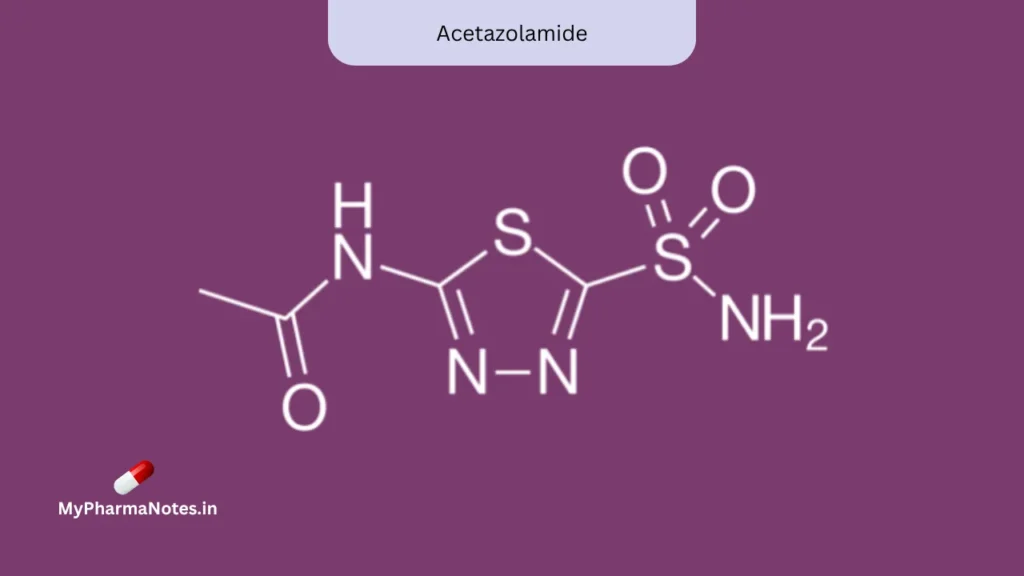
IUPAC Name: N-(5-Sulfamoyl-1,3,4-thiadiazol-2-yl)acetamide
Mechanism: Inhibits carbonic anhydrase enzyme in the proximal convoluted tubule, reducing bicarbonate reabsorption and increasing sodium and water excretion in urine.
Uses:
Edema caused by heart disease — reduces fluid accumulation in tissues. Glaucoma — reduces production of aqueous humor in the eye, lowering intraocular pressure. Epilepsy — used as an adjunct in certain seizure types. Altitude sickness — prevents and relieves symptoms of acute mountain sickness by promoting deeper breathing and improved oxygenation.
Formulations: Tablets, Capsule, Eye Drops
Brand Names: Diamox
2. Furosemide (Frusemide)
Furosemide is the most important drug in this chapter. It is a loop diuretic — the most potent class of diuretics — and is one of the most prescribed drugs in the world for acute fluid overload conditions. In emergencies like acute pulmonary edema (fluid in the lungs), furosemide given intravenously can be life-saving within minutes.
The name Lasix comes from “lasts six hours” — describing its duration of action.
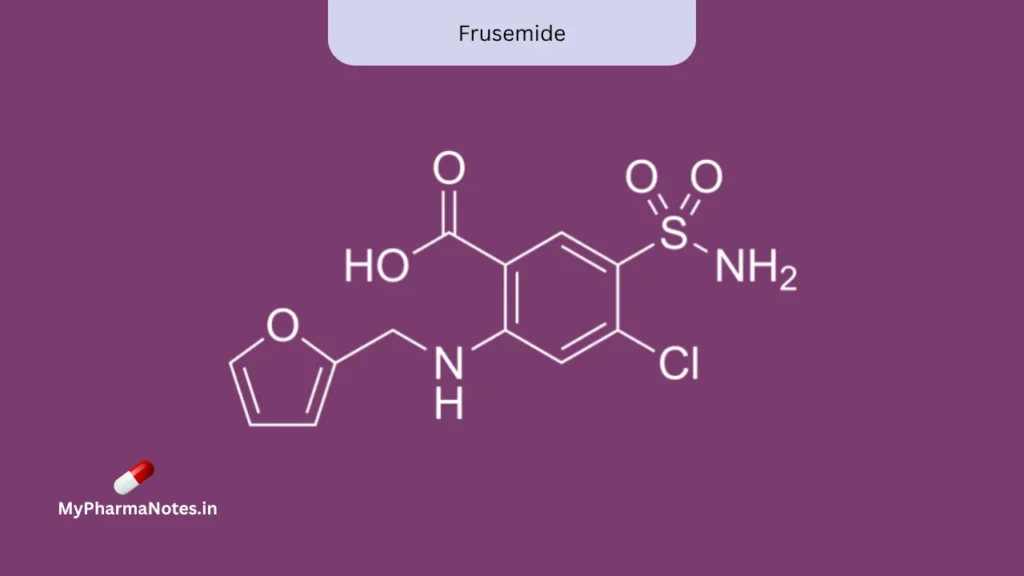
IUPAC Name: 4-Chloro-2-[(furan-2-ylmethyl)amino]-5-sulfamoylbenzoic acid
Mechanism: Blocks the Na⁺/K⁺/2Cl⁻ cotransporter in the thick ascending limb of the Loop of Henle. This prevents sodium, potassium, and chloride from being reabsorbed, leading to massive water excretion.
Uses:
Treatment of edema caused by congestive heart failure, liver cirrhosis, and kidney disease. Also used in hypertension, especially when other antihypertensives are insufficient. The drug marked with asterisk (*) in PCI syllabus — chemical structure required.
Important side effects to know for exams: Hypokalemia (low potassium) — because potassium is lost along with sodium. Ototoxicity (hearing damage) at high doses. This is why furosemide should be used carefully in patients on aminoglycoside antibiotics, which are also ototoxic.
Formulations: Tablets, Capsule
Brand Names: Lasix
3. Bumetanide
Bumetanide is also a loop diuretic, working at the same site as furosemide. The key clinical fact about bumetanide is its potency — it is approximately 40 times more potent than furosemide by weight, meaning 1 mg of bumetanide produces roughly the same diuresis as 40 mg of furosemide.
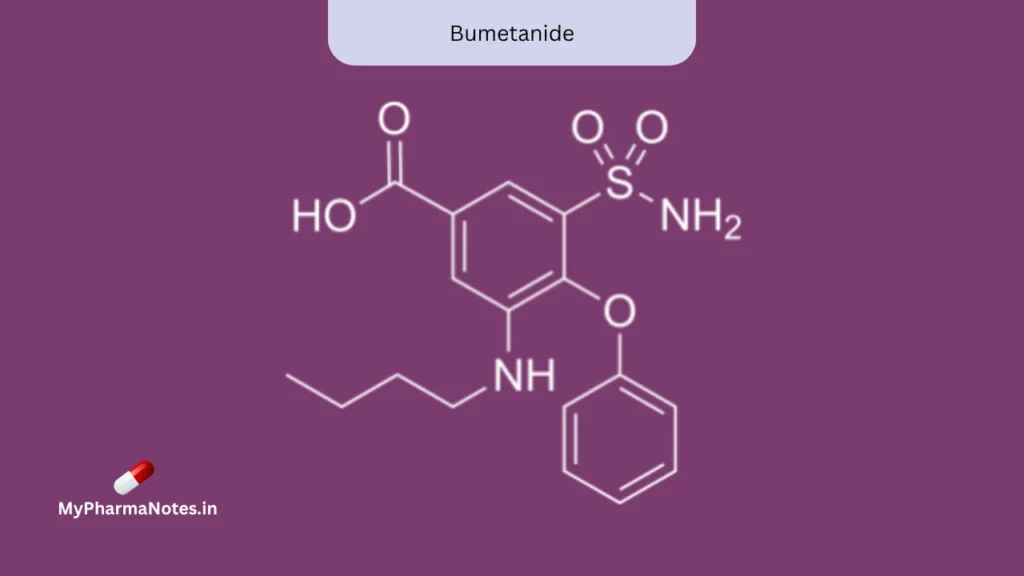
IUPAC Name: 3-butylamino-4-phenoxy-5-sulfamoyl-benzoic acid
Mechanism: Blocks the Na⁺/K⁺/2Cl⁻ cotransporter in the ascending Loop of Henle, same as furosemide.
Uses:
Treatment of edema associated with heart failure, kidney disease, and liver disease. Used as an alternative to furosemide in patients who develop resistance to furosemide or in those with furosemide allergy.
Formulations: Tablets, Capsule, Injection
Brand Names: Bumex
4. Chlorthalidone
Chlorthalidone is classified as a thiazide-like diuretic. Structurally it is not a true thiazide (it lacks the benzothiadiazine ring), but it works at the same site in the nephron and has similar effects. What distinguishes chlorthalidone clinically is its exceptionally long duration of action — up to 48 to 72 hours — compared to hydrochlorothiazide’s 12 to 24 hours.
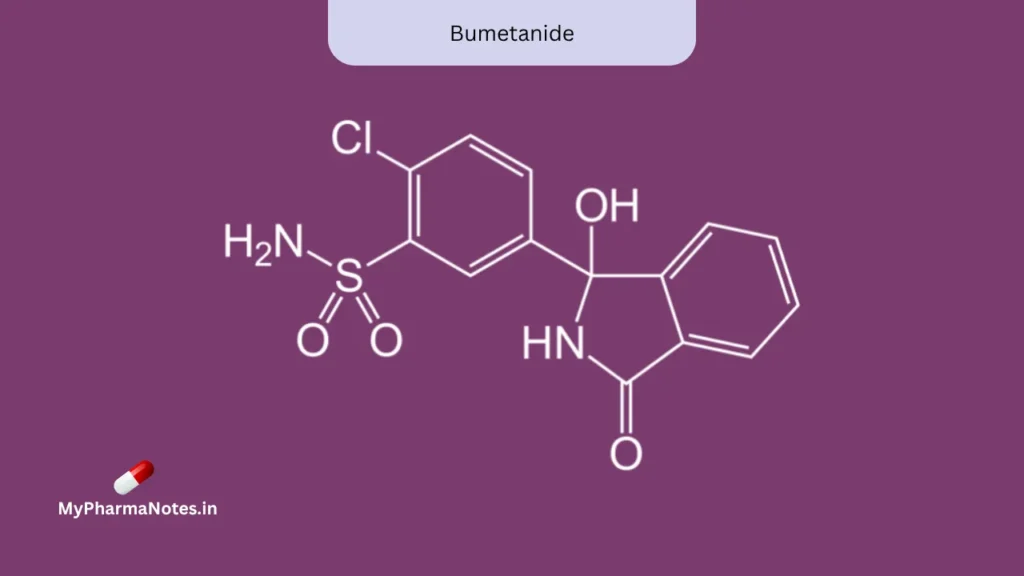
IUPAC Name: (RS)-2-Chloro-5-(1-hydroxy-3-oxo-2,3-dihydro-1H-isoindol-1-yl)benzene-1-sulfonamide
Mechanism: Inhibits the Na⁺/Cl⁻ cotransporter in the distal convoluted tubule, reducing sodium reabsorption.
Uses:
Treatment of hypertension, either alone or combined with other antihypertensives. Also used for mild to moderate edema in cardiac and renal conditions.
Formulations: Tablets, Capsule
Brand Names: Thalitone
5. Benzthiazide
Benzthiazide is a true thiazide diuretic — it contains the classic benzothiadiazine ring structure. Like all thiazides, it acts on the distal convoluted tubule and causes moderate diuresis. It is one of the earlier thiazide drugs and is now less commonly prescribed than newer agents, but it remains in the D Pharma syllabus.
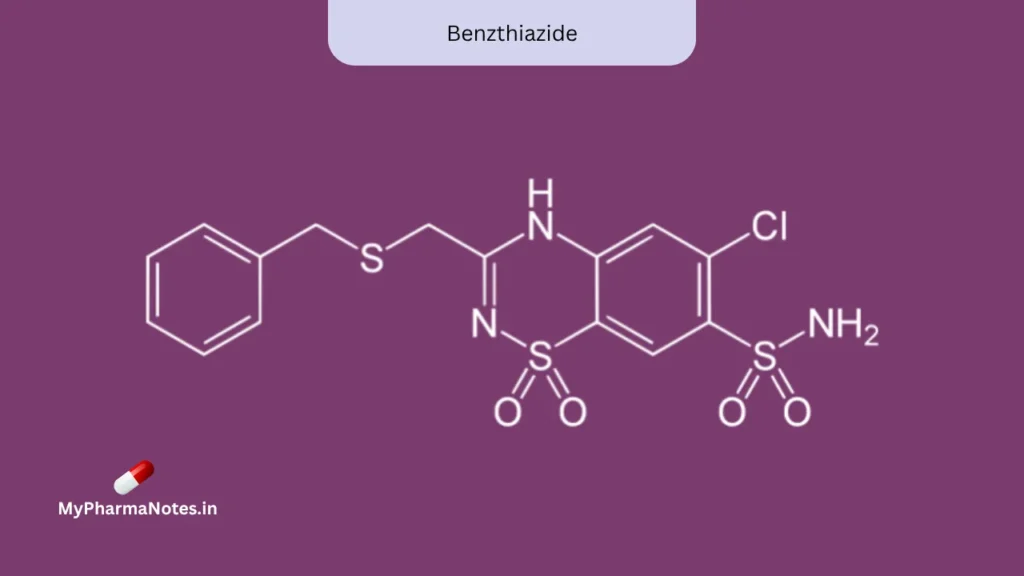
IUPAC Name: 7-Sulfamoyl-1,2,4-benzothiadiazine 1,1-dioxide
Mechanism: Blocks Na⁺/Cl⁻ cotransporter in the distal convoluted tubule. Unlike loop diuretics, thiazides are less effective when kidney function is significantly impaired (low GFR).
Uses:
Hypertension — lowers blood pressure by reducing blood volume and causing vasodilation with prolonged use. Edema associated with heart, liver, kidney, or lung disease.
Formulations: Tablets, Capsule
Brand Names: Aquatag, Dihydrex, Diucen
6. Metolazone
Metolazone occupies a unique position among thiazide-like drugs. While most thiazides stop working in patients with poor kidney function, metolazone retains its diuretic effect even in advanced renal impairment. This makes it valuable in patients with both heart failure and chronic kidney disease.
It is also commonly combined with furosemide in patients with diuretic resistance — a combination that produces dramatically increased urine output.
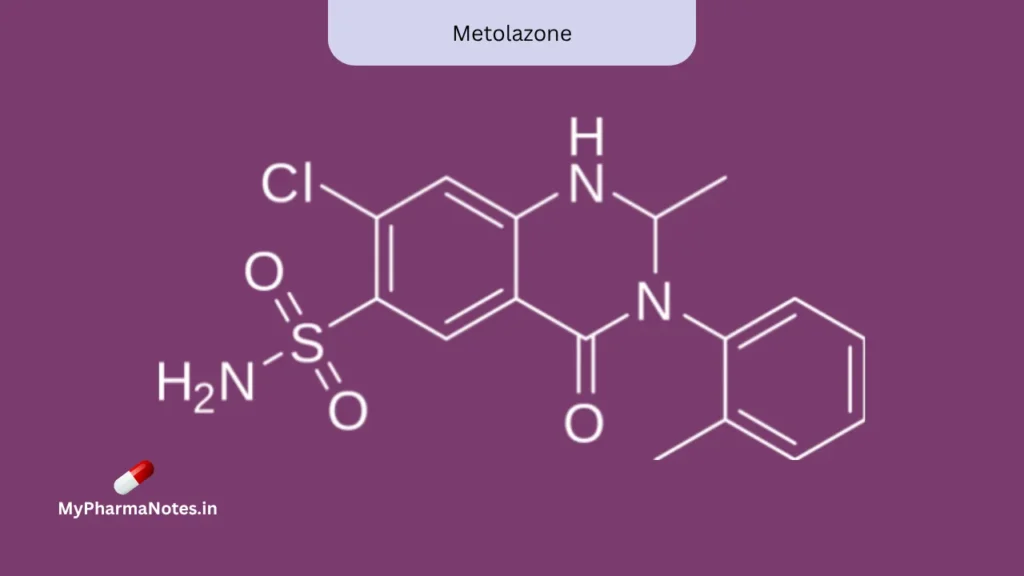
IUPAC Name: 7-chloro-2-methyl-4-oxo-3-o-tolyl-1,2,3,4-tetrahydroquinazoline-6-sulfonamide
Mechanism: Blocks Na⁺/Cl⁻ cotransporter in the distal convoluted tubule, similar to thiazides, but also has some proximal tubule activity.
Uses:
Edema caused by heart failure or kidney disease. Hypertension, alone or combined. Particularly useful in diuretic-resistant patients and those with reduced kidney function.
Formulations: Tablets, Capsule
Brand Names: Zytanix, Metoz
7. Xipamide
Xipamide is another thiazide-like diuretic that acts primarily on the distal convoluted tubule. Structurally, it is derived from chlorosalicylamide and has a benzamide core — different from the classic benzothiadiazine ring of true thiazides, but functionally similar. It also has some loop diuretic activity at higher doses.
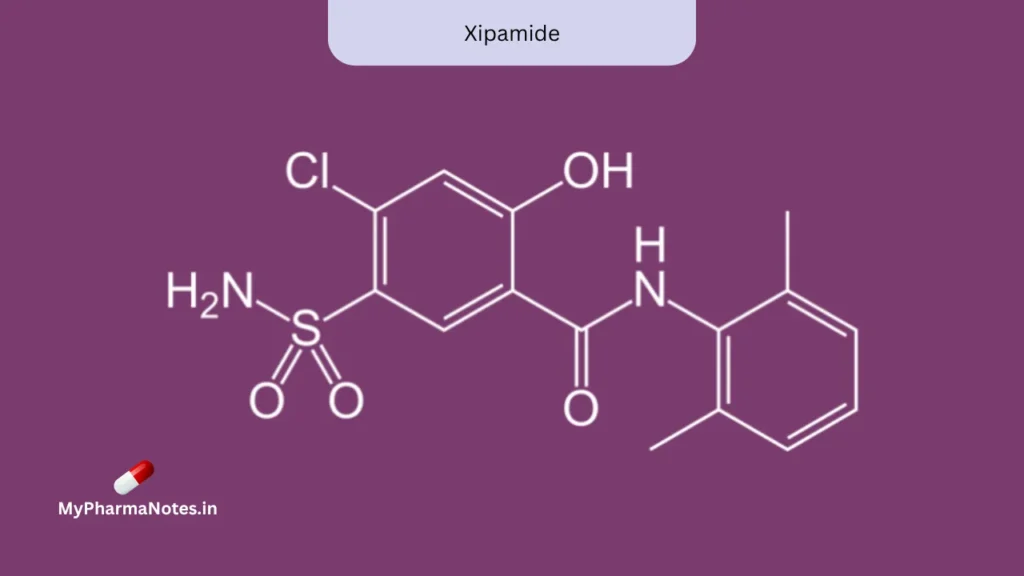
IUPAC Name: 4-chloro-N-(2,6-dimethylphenyl)-2-hydroxy-5-sulfamoylbenzamide
Mechanism: Inhibits sodium reabsorption in the distal convoluted tubule. At higher doses, also inhibits reabsorption in the proximal tubule.
Uses:
Hypertension — reduces blood pressure through sodium and water depletion. Edema associated with heart, liver, kidney, or lung disease.
Formulations: Tablets, Capsule
Brand Names: Aquaphor
8. Spironolactone
Spironolactone is fundamentally different from all the other drugs in this chapter — it is the only potassium-sparing diuretic in the syllabus, and it works through a completely different mechanism. All the drugs above cause potassium loss as a side effect. Spironolactone does the opposite — it conserves potassium.
It works by blocking aldosterone, a hormone produced by the adrenal cortex that normally tells the kidneys to retain sodium and excrete potassium. By blocking aldosterone’s effect, spironolactone causes sodium excretion while retaining potassium.
Beyond diuresis, spironolactone has become increasingly important in cardiology and dermatology. It reduces mortality in heart failure, and at lower doses it is widely used for hormonal acne and hirsutism in women.
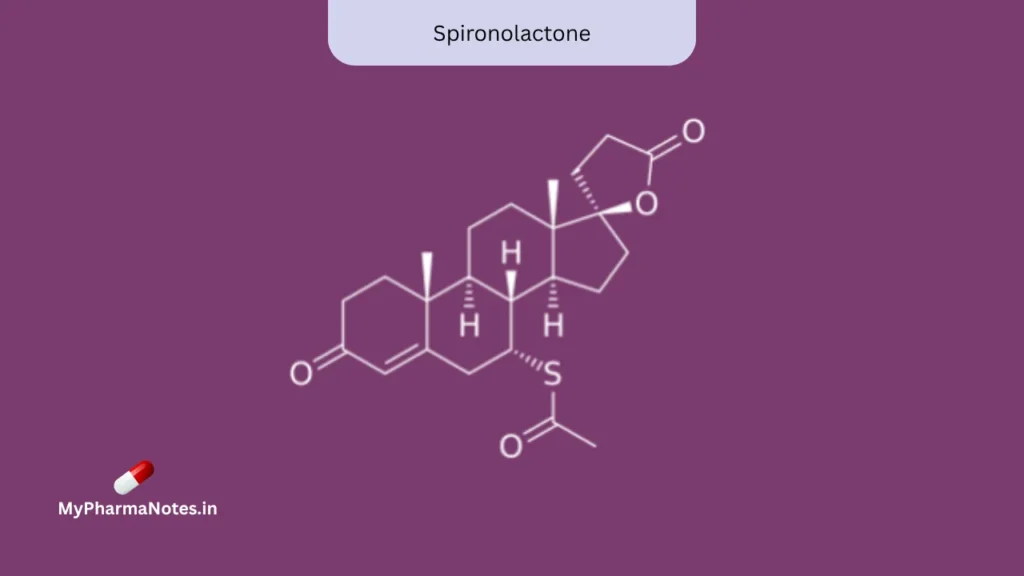
IUPAC Name: S-[(7R,8R,9S,10R,13S,14S,17R)-10,13-Dimethyl-3,5′-dioxospiro[2,6,7,8,9,11,12,14,15,16-decahydro-1H-cyclopenta[a]phenanthrene-17,2′-oxolane]-7-yl]ethanethioate
Mechanism: Competitive antagonist of aldosterone at mineralocorticoid receptors in the collecting duct. Blocks aldosterone-mediated sodium reabsorption, leading to sodium and water loss while retaining potassium.
Uses:
Hyperaldosteronism — conditions where the body overproduces aldosterone. Hypokalemia — low potassium caused by other diuretics, corrected by adding spironolactone. Heart failure — reduces mortality in patients with moderate to severe heart failure. Edema from liver cirrhosis and kidney disease. Also used off-label for acne, hirsutism, and polycystic ovary syndrome (PCOS) in women.
Important exam point: Spironolactone can cause hyperkalemia (excess potassium) as a side effect — the opposite problem from other diuretics. It should not be combined with ACE inhibitors or potassium supplements without monitoring.
Formulations: Tablets, Capsule
Brand Names: Aldactone
Comparison Table – All 8 Diuretics at a Glance
| Drug | Class | Site of Action | Key Use | Brand |
|---|---|---|---|---|
| Acetazolamide | Carbonic anhydrase inhibitor | Proximal convoluted tubule | Glaucoma, Altitude sickness, Edema | Diamox |
| Furosemide | Loop diuretic | Ascending Loop of Henle | Acute edema, Heart failure | Lasix |
| Bumetanide | Loop diuretic | Ascending Loop of Henle | Edema, Alternative to furosemide | Bumex |
| Chlorthalidone | Thiazide-like | Distal convoluted tubule | Hypertension | Thalitone |
| Benzthiazide | True thiazide | Distal convoluted tubule | Hypertension, Edema | Aquatag |
| Metolazone | Thiazide-like | DCT + Proximal tubule | Resistant edema, CKD patients | Zytanix |
| Xipamide | Thiazide-like | Distal convoluted tubule | Hypertension, Edema | Aquaphor |
| Spironolactone | Potassium-sparing | Collecting duct | Heart failure, Hyperaldosteronism | Aldactone |
High-Yield Exam Points – Chapter 8 (Diuretics)
Furosemide is the only drug marked with asterisk (*) in this chapter — chemical structure is required. All other drugs only need IUPAC name.
Loop diuretics (furosemide and bumetanide) are the most potent — act at the Loop of Henle where 25% of sodium reabsorption occurs.
Thiazide and thiazide-like diuretics (chlorthalidone, benzthiazide, metolazone, xipamide) act at the DCT where only about 5 to 8% of sodium is reabsorbed — hence less potent than loop diuretics.
Most diuretics cause hypokalemia (potassium loss) — all except spironolactone, which causes hyperkalemia.
Metolazone is the only thiazide-like drug that works in patients with reduced kidney function (low GFR).
Acetazolamide is the only diuretic in this chapter also available as eye drops — because it reduces aqueous humor formation in glaucoma.
Bumetanide is 40 times more potent than furosemide by weight.
FAQ – Diabetes
What is the most potent class of diuretics?
Loop diuretics are the most potent class. Furosemide and bumetanide both belong to this class and act on the ascending Loop of Henle, where the largest proportion of sodium reabsorption outside the PCT occurs.
Which diuretic is used for altitude sickness?
Acetazolamide (Diamox) is used to prevent and treat acute mountain sickness. It works by inhibiting carbonic anhydrase, which stimulates deeper breathing and improves oxygenation at high altitudes.
What is the difference between furosemide and bumetanide?
Both are loop diuretics with the same mechanism and site of action. The main difference is potency — bumetanide is approximately 40 times more potent by weight. Bumetanide is used when patients are resistant to furosemide or allergic to it.
Why is spironolactone called a potassium-sparing diuretic?
Because it blocks aldosterone receptors in the collecting duct, it prevents sodium reabsorption without triggering potassium excretion. All other diuretics in this chapter cause potassium loss as a side effect. Spironolactone retains potassium, which is why it is sometimes combined with loop or thiazide diuretics to balance potassium levels.
What is the IUPAC name of Furosemide?
4-Chloro-2-[(furan-2-ylmethyl)amino]-5-sulfamoylbenzoic acid
Which diuretics are used in hypertension?
Chlorthalidone, benzthiazide, metolazone, and xipamide are the thiazide and thiazide-like diuretics used primarily for hypertension. Spironolactone and furosemide are also used in certain cases.
Why does furosemide cause ototoxicity?
At high doses, furosemide affects ion transport in the inner ear (stria vascularis), disrupting the endolymph composition. This leads to hearing impairment, especially when combined with other ototoxic drugs like aminoglycosides.
D.Pharma 1st Year — All Subjects Notes
D.Pharma 2nd Year — All Subjects Notes
