
Table of Contents
Chapter 3 of Community Pharmacy and Management moves from the broader profession into the actual day-to-day clinical task at the heart of community pharmacy: handling a prescription correctly. This chapter covers what a prescription is, its parts, the format it follows, the step-by-step dispensing process, what defines Good Dispensing Practice, and the common errors pharmacists must guard against. This is one of the most practical and frequently tested chapters in the syllabus, since it directly relates to real pharmacy floor operations.
What is a Prescription?
A prescription is an order written by a physician, dentist, or any other qualified medical practitioner, instructing the pharmacist to compound and dispense a specific medication for an individual patient.
In essence, a prescription acts as a direct link between the physician, the pharmacist, and the patient. It carries silent but critical information regarding how the prescribed medication should be dispensed — making accurate reading and interpretation by the pharmacist essential.
Parts of a Prescription
A standard prescription is divided into three main sections: Heading, Body, and Closing.
1. Heading
The heading contains two key elements:
- Date — Helps the pharmacist determine both the date the prescription was written and the date it is being filled, which matters for validity and dosage timing.
- Personal data of the patient — Includes the patient’s name, sex, age, and address.
- Name and address are recorded primarily to correctly identify the prescription in case of any dispute or follow-up.
- Sex and age are particularly important in pediatric cases, helping the pharmacist verify that the prescribed dose is appropriate for the patient.
2. Body
The body of the prescription has three components:
- Superscription — Represented by the symbol “Rx,” an abbreviation of the Latin word recipere (meaning “take you” or “recipe”). The symbol is traditionally associated with Jupiter, regarded as the god of healing, and was historically used as an invocation for the patient’s quick recovery.
- Inscription — The main part of the prescription, containing the name and quantity of the ingredient(s) along with the manner in which the medicine should be taken.
- Subscription — Contains the prescriber’s specific directions to the pharmacist regarding how to prepare the prescription and how many doses are to be dispensed.
3. Closing
- Signature of the physician — The prescription must be signed in the prescriber’s own hand. In the case of dangerous or controlled drugs, the physician’s address and registration number must also be included.
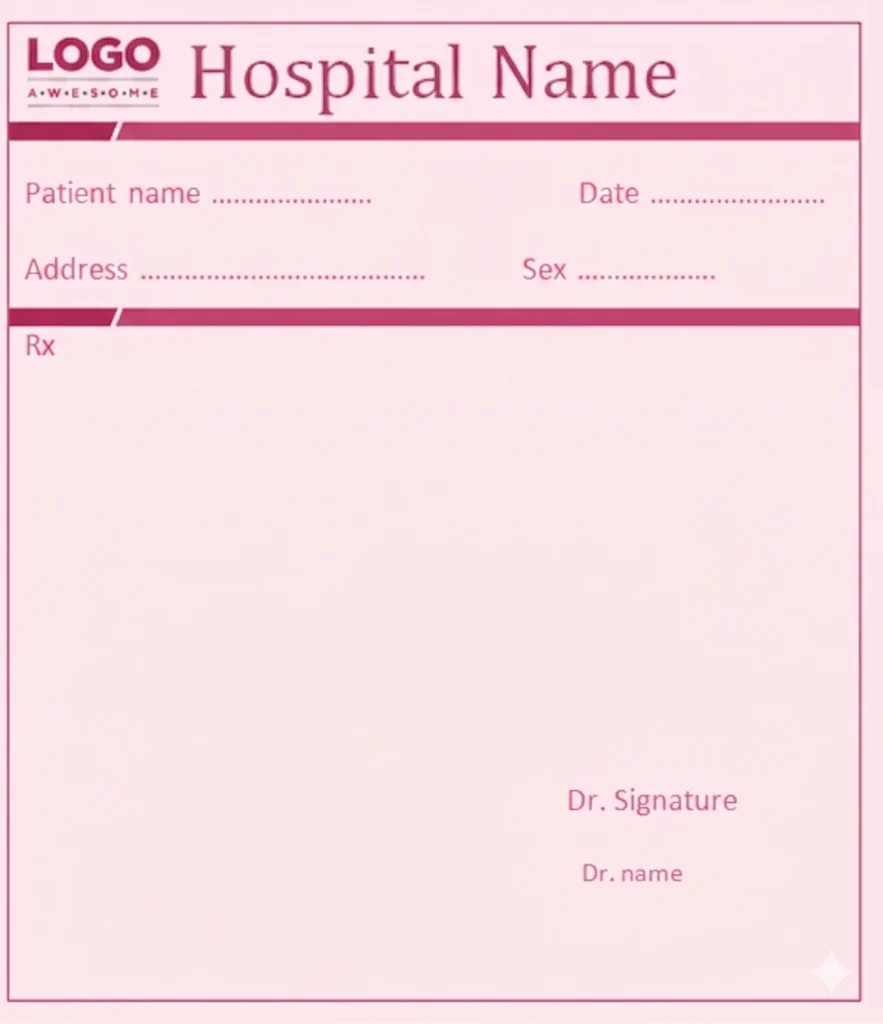
A typical prescription format includes the hospital/clinic name and logo at the top, followed by fields for patient name, date, address, and sex, then the “Rx” section for the actual prescribed medication, and finally the doctor’s signature and name at the bottom.
Handling of Prescription / Dispensing Process
Proper prescription handling follows a defined sequence of steps to minimize errors and ensure patient safety:
1. Receiving
The pharmacist should personally receive the prescription directly, followed by reading and checking it carefully before proceeding.
2. Reading and Checking
The prescription should be read completely and carefully from top to bottom, and checked thoroughly for any incompatibility between the prescribed ingredients or doses.
3. Collecting and Weighing the Material
Before compounding begins, all required materials should be collected and placed on the left-hand side (LHS) of the balance. After weighing, the material is shifted to the right-hand side (RHS) of the balance — this provides a built-in check on what has already been weighed during compounding.
To avoid errors, the label of every stock container should be read at least three times:
- When taken from the shelf or drawer
- When the contents are removed for weighing or measuring
- When the contents are returned back to their proper place
4. Compounding, Labeling and Packing
Compounding should always be carried out in a clean, organized space using equipment that has been thoroughly cleaned and dried. Only one prescription should be compounded at a time to avoid mix-ups. The label size should be proportional to the size of the container, and it must clearly include the necessary instructions for the patient.
5. Final Check
A final check should be made, the action taken should be recorded, and the medicine should be issued to the patient along with clear verbal and written instructions and advice.
Good Dispensing Practice
Good Dispensing Practice ensures that the right medicine, of the desired quality, is delivered correctly to the right patient — with the right dose, strength, frequency, dosage form, and quantity — accompanied by clear written and verbal instructions, and packaged appropriately to maintain the medicine’s quality and efficacy.
A safe, clean, and well-organized working environment forms the foundation of good dispensing practice. This environment typically includes:
- Qualified and trained staff
- Appropriate physical surroundings
- Adequate shelving and storage areas
- Proper work surfaces
- Suitable equipment
- Necessary packaging materials
Dispensing Errors and Strategies to Minimize Them
Dispensing errors can arise from multiple sources during day-to-day pharmacy operations. Common causes include:
- Legibility issues — Poorly written or unclear prescriptions can easily be misread.
- Lack of independent checking — Often, no second person is available to recheck the full medication being dispensed.
- High customer volume — A heavy customer load reduces the time available to properly process each prescription, increasing the chance of mistakes under pressure.
- Lack of concentration — Dispensing demands full attention; any lapse in focus can directly lead to errors.
- Distractions from phone calls and social media — Staying off personal devices during working hours is essential to maintaining accuracy.
- Lack of experience — Experience plays a significant role in recognizing and avoiding common dispensing pitfalls.
Strategies to minimize dispensing errors include:
- Ensuring correct entry of the prescription into records
- Confirming that the prescription is correct and complete before proceeding
- Reducing distractions wherever possible
- Being alert to look-alike, sound-alike (LASA) drugs
- Being especially careful with zeros and abbreviations in dosage instructions
- Keeping the workplace organized and clutter-free
Exam Tips
- The three parts of a prescription (Heading, Body, Closing) and their sub-parts (Superscription, Inscription, Subscription) are a guaranteed short-answer or fill-in-the-blank topic — memorize the Rx symbol’s origin (Latin “recipere,” linked to Jupiter) as it’s a frequently asked one-mark question.
- The “read the label 3 times” rule during the weighing step is a commonly tested practical point — remember the three specific instances it applies to.
- For long-answer questions, structure your response as: Definition of prescription → Parts of prescription → Prescription format → Dispensing process (5 steps) → Good Dispensing Practice → Common errors and prevention strategies.
- LASA (look-alike, sound-alike) drugs and “careful with zeros and abbreviations” are recurring keywords examiners look for in error-prevention answers — use these exact terms in your response.
FAQ – Prescription
What are the three main parts of a prescription?
A prescription is divided into the Heading (date and patient data), Body (superscription, inscription, subscription), and Closing (physician’s signature).
What does the symbol “Rx” stand for?
“Rx” is an abbreviation of the Latin word recipere, meaning “take you,” and is traditionally associated with Jupiter, regarded as the god of healing.
What are the main steps in handling a prescription?
The main steps are receiving, reading and checking, collecting and weighing the material, compounding/labeling/packing, and a final check before issuing the medicine to the patient.
What is Good Dispensing Practice?
Good Dispensing Practice ensures the right medicine, dose, strength, and dosage form is delivered to the right patient with clear instructions and appropriate packaging to maintain its quality and efficacy.
What are common causes of dispensing errors in a pharmacy?
Common causes include illegible prescriptions, lack of independent rechecking, high customer volume, poor concentration, distractions from phones or social media, and lack of experience.
