Table of Contents
Introduction of classification of Drugs
Drugs are chemical constituents which are obtained by the natural/herbal sources or synthetic source.
Technically and legally the term drug as defined in India under Drugs and Cosmetics Act of 1940 reads as follows.
- All medicines for internal or external use of human beings or animal and all substances intended to be used for or in diagnosis, treatment, mitigation or prevention of disease in human beings or animals.
- Such substances, other than food, intended to affect the structure or any function of the human body or intended to be used for the destruction or vermin or insects, which cause disease in human beings or animals as may be specified from time to time by the Central government by notification in Official Gazette.
- Classification is required for each drug because they are not similar in many expect like chemical, mode of action, morphological etc. If we are not classified them then we face many problem that is drug identification, drug adverse effect, and drug action.
- For the identification and separation of drug with each other classification is required in many ways.
Classification of Drugs
- Alphabetical classification.
- Taxonomical classification.
- Morphological classification.
- Pharmacological classification.
- Chemical classification.
- Chemo-taxonomical classification.
- Serotaxonomical classification.
Alphabetical classification of Drugs
Alphabetical classification is the simplest way of classification of any disconnected or alphabetically similar crude drug. That means drug which are belong to similar alphabet then it place the similar group.
Crude drugs are arranged in alphabetical order of their Latin and English names (common names) or sometimes local language names (vernacular names). Some of the pharmacopoeias, dictionaries and reference books which classify crude drugs according to this system are as follows.
- Indian Pharmacopoeia (English)
- British Pharmacopoeia (English)
- British Herbal Pharmacopoeia (English)
- United States Pharmacopoeia (English)
- British Pharmaceutical Codex. (English)
- European Pharmacopoeia (Latin)
- Pharmacopoeia Internationalis (Latin)
Taxonomical classification
In that classification drugs are classified on the basis of their division, class, sub-class, order, family, genus and species. It is type of biological classification and restricted mainly to crude drugs from plant source. It is criticized for its failure to recognise the organised or unorganised nature of crude drugs in their morphological studies. The taxonomical system of classification can be elaborated further as follows.
| Class | Order | Family | Drugs |
|---|---|---|---|
| 1. Gymnospermae | Ephedrales | Ephedraceae | Ephedra |
| 2. Angiospermae | |||
| Subclass: Monocotyledonae | Poles | Graminae | Maize,wheat, rice |
| Asparagales | Liliaceae | Aloe | |
| Zingiberales | Zingiberaceae | Turmeric | |
| Dicotyledonae | Rutales | Rutaceae | Cardamom Lemon peel,bael Orange peel |
| Rosales | Rosaceae | Rose oil | |
| Rosles | Leguminosae | Balsam tolu, senna, Tragacanth | |
| Umbelliflorae | Umbelliferae | Asafotida, fennel | |
| Contortae | Apocynaceae | Rauwolfia, vinca | |
| Tubiflorae | Solanaceae | Datura, Belladona |
Morphological classification
In this types of classification, the crude drugs are divided into the parts of plants like leaves, fruits, flowers, woods, barks, extract, gums etc.
| Part of Plant | Drugs |
|---|---|
| Woods | Quassia, Guaiacum, Sandalwood. |
| Flowers | Clove, Rose, Saffron etc. |
| Barks | Cinnamon, Arjuna, Cinchona, etc. |
| Seeds | Linseed, Nutmeg, Nux-vomica, etc. |
| Gums | Guar, Ghatti, Acacia etc. |
| Dried Juices | Aloe, Red gum, Kino. |
| Fruits | Bael, colocynth, lemon, orange, Coriander. |
| Extracts | Catechu, Agar, Gelatin. |
| Subterranean- Parts | Ginger, Rhubarb. Turmeric, Aconite, Rauwolfia. |
This type of classification is more convenient for practical purposes, even if the chemical nature is not known, a drug can be studied on the basis of their morphological and pharmacological characteristics.
- This type of classification is very useful in identifying the adulterants used.
In the natural state crude drugs from plant source can be readily distinguished but operations like collection, drying, preparation for the market produce distortion of the natural form making their recognition very difficult.
- Animal drugs and mineral drugs are difficult to classify by this method.
On the basis of morphology drugs are divided into two parts.
- Organized drugs.
- Unorganized drugs.
| Organised Drug | Unorganized Drug |
|---|---|
| These are obtaining by the Plant and animal sources. | These are also obtaining by plant and animals sources but also found by minerals sources. |
| These are obtain direct part of plants or animals (Dried or Fresh) | These are the products of Plants & animals. |
| They contain well defined cellular structure & solid in nature | They do not have well defined cellular structure & they are solid, semisolid or liquid in nature. |
| They defined the morphological character of the Plants or animals. Ex: Digitalis leaf, Ephedra stem, clove bud, Tulsi leaf etc. | The defined the organoleptic character like (Teste, Odour, etc.) Ex: Agar, Gelatin, Honey, Essential oil. |
Pharmacological classification
In this classification drugs are placed together, which show the similar pharmacological function or therapeutic effects.
Drug action is a specific function for each drug due to its chief chemical constituents. Chemicals are bind to the specific receptors of our body and play a great role in the therapeutics. Some crude drug are classified below.
| Pharmacological action | Examples |
|---|---|
| Drug action on Nervous system | Opium, cannabis, nux-vomica, Belladona, ephedra. |
| Carminatives | Coriander, caraway, cinnamon, clove. |
| Laxatives | Castor oil, Ispaghula, senna. |
| Astringents | Catechu. |
| Diuretics | Gokhru, punarnava. |
| Cardiotonics | Digitalis, arjuna. |
| Antihypertensive | Rauwolfia |
| Antirheumatics | Guggal, colchicum. |
| Antitumor | Vinca |
| Antimalarial | Cinchona |
| Antidiabetics | Pterocarpus, gymnema sylvestro. |
| Antitussives | Vasaka, tolu balsam, Tulsi. |
| Bitters | Nux- vomica, cinchona, gentian. |
- The special advantages which the method enjoys is that even if the content of the crude drugs are not known, they can be classified properly on the basis of therapeutics or pharmacological property.
- Pharmaceutical Aids are also a crude drugs, which are not place in this classification because pharmaceutical Aids shows many pharmacological effects.
- However, the drugs which are dissimilar in their action of mechanism even though their therapeutic effects is same (Example- bulk purgative and irritant purgatives etc.) are put together.
- It is also possible that the same drugs with two different actions in the body, may be classified separately at both the places. for example cinchona is grouped as antimalarials and bitters and stimulants.
Chemical classification
In this classification crude drug are put together, which are contains the similar chemical constituents. It is very important expect in the classification system because chemicals are responsible for the pharmacological action.
It is very important for the phytochemical study of crude drugs. Chemical classification is given below.
| Type of chemicals | Examples |
|---|---|
| Alkaloids | Cinchona, nux-vomica, belladonna, ipecac, vinca, opium, tea, aconit |
| Glycosides | Digitalis, liquorice, senna, squill, aloe, dirscorea. |
| Volatile oils | Peppermint , clove, eucalyptus. |
| Tannins | Kino, catechu. |
| Resins | Benzoin, tolu balsam, asafoetida, Myrrh, Guggal. |
| Vitamins | Yeast, cod liver oil, shark liver oil. |
| Carbohydrate | Agar, honey,starch, tragacanth,acasia. |
However, this type of classification fails in proper placement of drugs containing two different types of chemicals. For examples, certain drugs are found to contains alkaloids and glycosides (cinchona), Fixed oil and volatile oil (nutmeg), fixed oil and enzymes (bitter almond) together and hence makes it difficult to categorize them systematically.
Chemo-taxonomical classification
In this classification combine the two classifications for defining the crude drugs. In which we investigate the drug category and chemical composition. Many crude drugs which contain the chemical constituents which are belong to the similar classes or closely related to similar species or family or division.
- In this system, equal importance is given for taxonomical status and chemical constituents. There are certain types of chemical which are characteristics the specific classes of plants.
- The character most often studied in chemotaxonomy are secondary metabolites of pharmaceutical significance such as alkaloids, glycosides, flavonoids etc.
Serotaxonomical classification
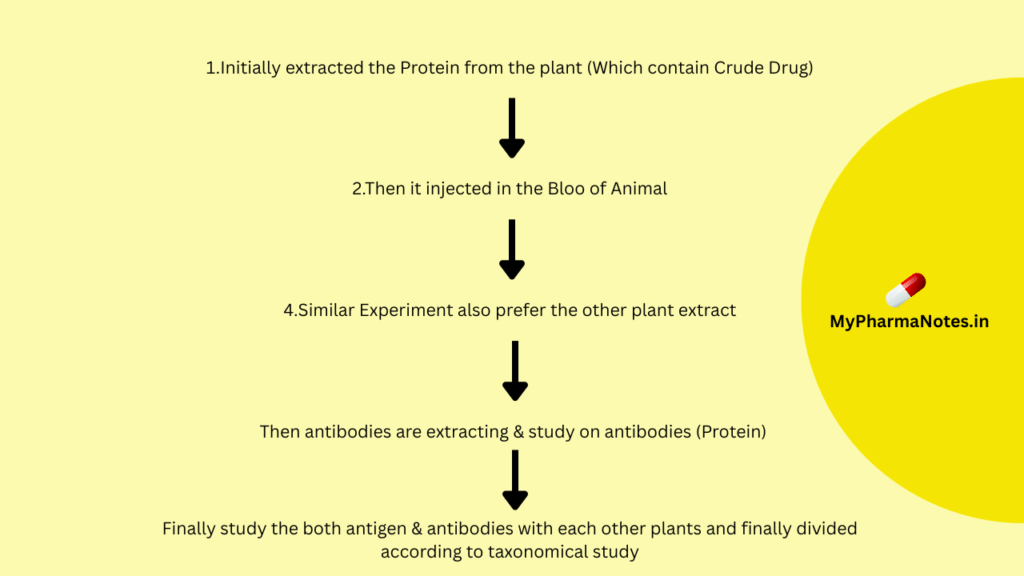
This technique is based on the highly specific relationship between antigens and the antibodies produced in response to the animal during the any infection or harm.
- Serology is the scientific study of the blood for the diagnosis of our immunity power or define our immunity efficiency by the production of antibodies against the pathogens or introduce substances.
- It is mainly based on the protein content, which are present in the plants or crude drugs. Different protein contents are divided the crude drugs in different categories.
D.Pharma 1st Year — All Subjects Notes
D.Pharma 2nd Year — All Subjects Notes
